Wednesday, January 30, 2013

Migration as fairy tale (Review of "Viva Cuba")


Political repression has always been accompanied by migration. The two are inextricably tied together, and understandably there is always an economic dimension as well. Political groups that are banned or outlawed are cut off from institutional support, and thus, are forced to scramble In circumstances that are already quite difficult. I am thinking, of course, of cases such as North Korea, which is once again in the news with threats directed against its neighbors to the south and east, and to Cuba.

Migration from Cuba has been an ongoing response not only to economic uncertainty but also to political repression. Cuba has been undergoing what would seem to be a long-overdue transformation, and there has supposedly been an opening up of the economy. Market reforms are being introduced, and while this has the potential of being destabilizing, it might in the long run insure the survival of the current political regime.

North Korea is another matter. The news stories seem always to highlight the results of repression and mismanagement, and there were stories recently of supposed cases of cannibalism in the face of a renewed, hidden famine. The new leader, Kim Jung Il, seems ready to follow the lines of his father, and to engage in exercises in bellicosity while maintaining a secretive power structure and a closed society. Were those borders to open up, one wonders how many millions might pour out of North Korea. It is a prospect that supposedly alarms China, their one last ally.

Recently I had a chance to see the 2005 film “Viva Cuba”. The dynamics of migration are featured in this film, but in an underhanded way. One of the positive reviews highlights that this work supposedly “depoliticizes” the phenomenon of migration, but it certainly doesn’t lend any more clarity to the issue.

The film details the exploits of two children, Jorgito and Malú, who are about to be separated. It seems that Malú’s mother has married a foreigner in a bid to escape the island, and that she now has the perfect opportunity to enact this plan when her mother dies. One wonders at the dynamics of families that are, as ever, on the verge of separation, with adults who seem unable to get along.

The contrasts between the families are drawn in broad strokes. Jorgito’s family are stalwarts of the revolution, with photos of the revered leader, Fidel, in their house. Malú’s mom, on the contrary, seems to despise the revolution, and considers herself to be part of the hidden and aspiring middle classes. This leads to comical contrasts, but ones which are, as ever, too broad and easy to be really enjoyable. A little more subtlety would have been appreciated.

It seems as if the children have grown attached to each other, and they represent the two halves of Cuban society, waiting for what should be a natural reconciliation. The kids don’t want to be separated, as would happen if Malú’s mother succeeds in her plan to leave the island and take her daughter. And so, they embark on a quest to find the girl’s father, inform him of the situation, and hopefully prevent this separation.

The journey is filled with mishaps, but also, with adventure and magic. I appreciated the views of this Cuban landscape that seems almost too idealized. I say this because it almost seems like a middle-class vision, with little exploration of the restrictions and hardships involved in having to deal with a faltering economy that is being refashioned. Now, this is not to say that the children don’t experience hunger, or that they don’t fall sick, or that they don’t experience fear. They do, in episodes that recapitulate fairy tales, such as Hansel and Gretel (in their encounter with a blind woman in the forest who puts food out on the window sill, then hopes to imprison them) or the Little Red Riding Hood singing episode, but this is very much a children’s point of view. We don’t see the shortages and the grinding poverty that afflicts so many adults, the need to scrape while also trying to preserve a little bit of dignity.

This film seems like a wild caper that is very innocent, and in that way, deflects consideration from the true dynamics and consequences of migration. The children are, supposedly, meant to be together, and their loyalty to each other is touching, but this is ultimately an exercise in escapism that fundamentally tries to present an idealized Cuban landscape. Even the old icons are reaffirmed, as in the sequence at the end where the children encounter a bearded young man in the forest, one who takes them in and helps in their “subversive” plan to evade detection by the authorities so that they can reach Malu’s father who lives in a lighthouse on the other end of the island. The young bearded man furthermore rides a bicycle, and the comparison is inevitable to the film “The Motorcycle Diary” which details the voyage of Che Guevara as a young man through South America before he joined the Cuban revolution.

Perhaps we could all use a little more escapism. This film is certainly a far cry from the films of Tomás Gutiérrez Alea that were released in the 60s, films such as “Memorias del subdesarrollo” that were such seminal works in dealing with the psychological and social impact of revolution. Those films were instant classics, and they linger in my mind and memory as testaments to the Latin American condition, if it could be said that there is such a thing. They capture transformation and desire, but also, despair and anxiety.

Now we have films that present innocent capers by children in the form of modern day fairy tales, dressed up in modern clothing. This one also addresses a crumbling society, but there is no excitement that is implicit in the idea of a grand revolutionary project. It is, instead, perhaps a nostalgic view, and nostalgia also is an exercise in idealism. It creates its subject, because memory is also creation anew. We will never recapture the past as it was, because our vantage points have changed, as have our needs.

The film, this, is a little unfulfilling for me. The ending is meant to be somewhat poetic, and I won’t describe it here, but is also strikes me as enigmatic, because it leaves the two children as abandoned as they ever were. Their viewpoint is, as ever, limited and characterized by excessive sentimentality. And the acting seems at times too over-the-top. But the film does provide a view of how a modern day Cuban director has left behind the legacy of Alea to produce what are hopefully more commercially-accessible films. I’m just not sure that this approach will be any more successful in bridging the divisions that characterize Cuban society.

 
Viva Cuba is a 2005 Cuban film, directed by Juan Carlos Cremata and Iraida Malberti Cabrera, and written by Cremata and Manolito Rodriguez


Eternal Observer -- ORomero (c) 2013
Copyrights ORomero 2013

Wednesday, January 2, 2013

Apocalypse as Release


Review of After the Apocalypse

“Outside she checked her hair. She wasn’t on fire or anything, but she had blister on her arms and they hurt. God, she was stupid. She hadn’t known that was going to happen. She looked back at the house. Had it gone out? Part of her kind of wanted it to have gone out, like the grill did sometimes. But not really. She wanted to see fire. She wanted to see it burn.” (The Effects of Centrifugal Forces, p. 166)

“After the Apocalypse” is a title that sounds in keeping with our times. One can imagine it referring to the most recent and sordid episode of discord, that of the wrangle over reaching an arrangement to avoid the much ballyhooed “Fiscal Cliff” that hung like a noose over our collective heads during Christmas of 2012. For the past several months, ever since President Obama’s reelection, we have heard of little else, and the conservative sectors in particular have hunkered down and engaged in their perpetual mode of bluster and outrage to sabotage any possible agreement.  Doom was spelled out in earnest terms by newscasters and economists who reflected on the possibility of a world-wide slowdown and a renewed recession. What had been started by W. would be completed by the Tea Party, a group that represented only the latest reincarnation of our biblical prophets of doom.

The title in this case, however, refers to a collection of short stories by Maureen McHugh. They detail a variety of possible scenarios that can be constituted as signaling the putative end of the world. They describe various visions of possible apocalypses, with the consequent slow unraveling of the world. Strangely, perhaps because of the frustration and futility that comes with the experience of a poisonous political culture during the last few presidential terms and the lingering effects of a recession that have cast a haze on our collective sensibility and traditional optimism, these scenarios don’t sound in any way extravagant.

We have, for example, visions in which plagues figure prominently. For example, a mutation of the Avian Flu that kills hundreds of millions of people, leading to a culture in which people earnestly hope to collect mementos of their past lives. Things substitute for people and for missed affection as we all become collectors, but I ask myself, are things any different now in our material culture? In other stories we have references to another disease (perhaps the same one describe in other scenarios?), one called Avian Prion Disease (APD), one that eats away at the brain and incapacitates and ultimately kills those who are infected in five years.  And there is another scenario that is described in the first story and that harkens to the contemporary popular craze over zombie apocalypses, one in which zombies have been isolated in forbidden zones and in which they come to constitute a natural order that is, ultimately, more suited to the protagonist, an uninfected prison convict.

These scenarios are explored artfully, and we are treated to stories that are noteworthy for their psychological complexity and for their poetic grace. They are not one-note scenarios, nor melodramatic and hysterical narratives that are heavy on action with little reflection. We see instead the description of difficult social scenarios, in which scientists and those agents who we would presume would be addressing these problems never appear and instead we see ordinary people struggling to cope. There is no Deus ex Machina, no miraculous antibody or world order to set things right.

The scenarios are familiar, and they don’t seem entirely unfamiliar. We have all been struggling during these past years, dealing with a culture of poisonous political paralysis, with a strong note of paranoia and suspicion that, as eluded to before, has given rise to a narrative of American decline. We fear what is happening to our economy, and we fear as well the loss of our place in the world. Was it all an illusion, this culture of greed and inflated real estate prices, this binge that inevitably gave rise to a bust, with soaring foreclosure rates, a stubbornly high unemployment rate, a scaling back of expectations, a never-ending crisis in Europe and the Middle East and the recognition that yes, we are as vulnerable as we ever were to natural forces, those forces that seem to have become more destructive than they have ever been, as seen in the recent episode with Hurricane Sandy and the longstanding drought in the Mid West? Are these signs in a climate of impending doom? It is almost as if we have been recapitulating what we have been seeing, but in accelerated form.

Our societies are, indeed, fragile and the economic and social processes at play can be, as always, predatory. But even in the face of the apocalypse, we are subject to the same universal urges and the same responses. Perhaps an apocalypse is a reset, an opportunity for escape, a certain wish fulfillment that can be interpreted as a corrective, as a purging or cathartic experience. Perhaps that is part of the reason why we find them so compelling, although one must admit that they do seem to usher in a heightened dramatic note.

I am taken by stories such as “Useless Things”, a narrative of loss and futile substitution, told from the point of view of a middle-aged woman who has moved to New Mexico to fabricate dolls that she sells online and that she speculates are meant as substitutes for loved ones lost during the recent plague. There are, indeed, many “useless” things, but these dolls are certainly among that class of items, and the title is in the end ironic.  When so much of material culture is disappearing, when water has become as scarce as work and when people have taken to living in RVs out in the desert, we need to find those things that are still useful, and in this case, perhaps those things that are “useless” or those that serve to remind of the veneer of a past culture that is disappearing.

There is an urgency in this story, for the protagonist is forced to confront the evidence of the continuing existence of domestic squabbles, among those fortunate classes that still cling to a past lifestyle, out in the civilized cities that are in reality reservations. There are migrants trekking through the desert from down south, then as now, and they trace out the pattern of economic systems that continue to survive, even under duress. We are nothing if not flexible, and we cling to useless things, to the dogs that the protagonist keeps as pets even though they are unable to provide protection against strangers, or the tools that recall a past life for the character, or to family bonds such as that evident between the old man and his deranged, violent nephew who seems to lack any capacity for affection for his family. We cling to emotions and attachments and affection, because ultimately they are not luxuries, and this is part of the grace and satisfaction of the stories that explore these human sentiments and urges.

There are also stories that seem more genuinely marvelous in their scenarios, such as the one that narrates the possible arrival of what we can term artificial intelligence. It seems as if in the near future programs are fashioned that are able to create subroutines that are tested and that evolve into organic entities, and one of these is a program called DMS that is fashioned to analyze disease indicators and data that is fed to it by a network of sensory inputs. It is a fascinating story that deals, once again, with a readjustment in social relationships, as we become privy in this instance to the social contract that is in place between two programmers. Having been a programmer myself in a past incarnation, the dynamic sounds familiar and convincing, and I found myself identifying with the position of the protagonist who, as I was, is an outsider. She is an overweight female programmer who struggles under the shadow of a fellow worker who seems to be much more brilliant, but in reality, is unable to recognize his own limitations.

DMS, the nascent intelligence, is living as it is in the “Country of the Blind”, and seems to be unable to take cognizance of the existence of other intelligences.  It would seem to be “blind”, but in this instance, who is to say that we are any different? After all, aren’t we also living in a similar environment, one in which we are forced to reflect on whether we can give credence to the date that we receive from our own sensory apparatus? How do we distinguish ourselves from our bodies? It recalls the thought experiment formulated by Rene Descartes, that of consciousness taking the form of a brain in a vat, subjected to external stimuli and unable to tell whether our material sensations are not illusory, fed to us by some exterior agency running an experiment. The protagonist is herself insecure and unable to perceive the illusions that characterize her own relationships, and it is perhaps inevitable that she would come to identify with the DMS and seek to save it from being erased.

Another story feeds into this conceit of life as a simulation. It is called “Going to France”, and it deals with a dream-like scenario in which the fantastic combines with the everyday. It recalls the idea that is being explored by certain cosmologists who speculate that the universe is, indeed, a computer simulation being run by some higher entity. In this story we have people who are suddenly overcome by an urge to go to France, an irresistible urge that is shared by the protagonist, once again an unattached, middle-aged woman. Some people are able to fly by their own means, by which I’m not actually referring to their being able to piloting their own craft, but instead their ability to flap their arms and take flight across the Atlantic.  Others are unable to share this ability, but nonetheless drop everything they are doing in order to purchase airline tickets and succumb to this mysterious compulsion that almost seems to symbolize the way in which we are also subject to strange whims and compulsions that we can’t resist. Is it the power of the simulation?

Memes, like biological agents and viruses, are units of meaning that circulate freely within a culture and that control the way we think and perceive our world. It is a concept that was first formalized by the biologist Richard Dawkins, and has taken a place in the analysis of popular culture. If our material bodies are mediums for the transmission of DNA, then memes transmit the DNA of culture, and they represent elements that condition our perception and control to a certain extent our actions. Who doesn’t feel that we are all subject to hidden compulsions that belie the illusion of independence and control?  We are left with a reflection of what is it to be provoked and stimulated to act in strange ways, strange at least for the reader until he or she reflects on similar crazes that have characterized their own actions.

The stories frequently have notes of melancholy and confusion but they are describe processes in which our worlds are reordered. There is, after all, an atmosphere of ideological coherence even in these doomsday scenarios, and we see the protagonists expressing a very rational need to adjust. Some even thrive, such as the Chinese teenager Jieling in “Special Economics”, who finds an opportunity to benefit from a situation in which predatory capitalism and repressive labor policies have given rise to an indentured labor force. We are adaptable, after all, and the slow unraveling of the world will be met with attempts to compensate, to adopt strategies that, in the end, are familiar. It is all curiously rational, and in this way, the scenarios in this collection contrast with the apocalypses that were envisioned in J.G. Ballard’s novels, works such as “The Drowned World” that unfold at a lethargic pace, and that show their protagonists strangely unable to adjust to these processes of decline and transformation. Humanity in those novels finds itself in an evolutionary dead-end.

In McHugh’s stories we find a common thread. We are invited to question the conditions in which we find ourselves, those conditions that constitute the seeds of these future apocalypses, and to admire protagonists, frequently middle-aged women but also younger females, who are unattached and who, one must repeat, find a certain emancipatory potential n these situations. Perhaps we revert to our truest essence, a need to adapt and move on, and in this way, there is no real gloom in these scenarios.

We are left to wonder and ultimately admire the energy of the woman in the final story (“After the Apocalypse”), she who along with the remnants of American society are left to trek to the north, to Canada, as they attempt to escape the collapse of a society that has been hit by further dirty bombs wielded by terrorist forces. This escape is hair-raising, and she is trudging across a dangerous landscape with a curiously innocent daughter, one who she comes to recognize as a rival as well as burden. She abandons this teenage daughter to the protection of a young man they meet and joins up with a group of soldiers.

Her governing urge is escape, and her mode is to give in to her automatic impulses. “She doesn’t know where she is going. She is in motion.” And this motion seduces us all, even in these apocalypses.


Eternal Observer -- ORomero (c) 2013
Copyrights ORomero 2013

Thursday, December 20, 2012

Review of The Anubis Gate


The Anubis Gate is an award-winning novel published by Tim Powers over thirty years ago. It cannot be categorized properly as belonging to one single genre, since it combines elements of science-fiction as well as fantasy. It is an energetic work that proceeds at a fast pace, with plenty of action and little of the reflection and the moments of profound insight evident in the works of his friend, Phillip K. Dick. It is easy to see the influence of this work in other novels, such as Neil Gaiman’s Neverwhere.

It begins by introducing us to a setting: London in the early 19th century. It seems as if there is a secret organization of wizards and acolytes who are bent on restoring the power of magic in a Europe that has just concluded the Enlightenment and is moving into a tumultuous period of reform and renovation that will be heavily influenced by Romanticism. Indeed, the writer Samuel Coleridge, he of the famous poem Kubla Khan, will figure as a minor character in this work, and in this case, because of the way that it borrows from symbols and references evident in his work, it reminds me of the way that Dan Simmons has used other works and authors (such as Keat’s poetry in Hyperion) to flesh out what were fantastic scenarios and give them a veneer of science fiction. But this veneer is just that in Powers’ novel.

It seems as if we have a catalogue of eccentric characters who will collide and form unlikely alliances. We have, for example, the menacing dwarf Horrabin, he who puts on a particularly vicious Punch and Judy show and who will pursue the protagonist, and English professor named Brandon Doyle in an “Indiana Jones” type role. We also have a terrifying wizard by the name of Dr. Romany, and a whole host of minor characters who include the curious Curly Joe, a werewolf with the power to switch bodies. The intrigue involves a plot by the wizard and his master to instigate a plot against the British monarch, and to thereby undermine England and allow for the resurgence of Egypt as an independent nation, controlled by menacing wizards intent on restoring the old pantheon of Egyptian gods.

The plot, as noted before, is characterized by nonstop action. It begins with the discovery by an eccentric mechanism whereby people from 1983 can be sent back in time along gaps in the timeline, for, as described in the novel, time is a river that flow underneath a frozen surface, but at times, there are gaps in the cover that allow travellors to punch through the holes and enter into other select gaps that have been mapped out. The scientific rationale for this mechanism is very, very flimsy, and it is on a par with that provided by H.G. Wells in his novel The Time Machine. However, the rigorous extrapolation and sociopolitical speculations that are evident in the latter work situate is as a pioneering work of science fiction that continues to stimulate the imagination while appealing as well to a certain apocalyptic obsession that we seem to share as a culture. (Witness, for example, the nonstop stories in our public media about the Mayan prophecy regarding the end of the world, that is supposed to take place on Dec. 21, according to an ancient prediction.) In Powers’ work, however, the analogy and the mechanism hold no such rigorous framework, and instead, what we have is a potboiler full of action and thrilling escapes.

Doyle will quickly be abducted by Dr. Romany during his first journey to the past, and after that, will be constantly pursued. We are introduced, in the meantime, to situations and plots that interweave in unlikely ways, and Doyle will be aided by Jackie, a beggar who in reality is a man on a vendetta, and other minor characters. The villains are true villains, with a taste for torture and manipulation, and to my mind Horrabin the dwarf is the more terrifying figure, walking along as he does in stilts with a rictus of a smile permanently grafted to his mouth, as a premonition of the Joker so famous in the Batman series. Dr. Romany, the tall and lurching wizard with the deep booming voice and the mysterious powers, seems ultimately the weaker of the two, although at a certain point he will torture both Doyle (who has by now been settled into the body of his former graduate student, an athletic blond man who was a lackey to another figure of manipulation, the 20th century millionaire Mr. Darrow).

The novel is a page-turner, but there is precious little in the way of exploration of a true magical mindset. The action takes preeminence, and we have escapes as well as voyages and encounters with various figures, including the duplicate of Lord Byron. Since the author was an English major who studied at Cal State Fullerton, we see that he is eager to introduce them as minor characters, but they are strictly that, minor characters. We have instead the spectacle of Doyle, the former English professor, becoming an action figure who makes many heroic as well as unlikely escapes.

I wish I could say that there was an overall theme to this work. We have secret societies, such as that of the defenders of magic as well as the society of beggars. In this way, the work reminds me of characters and situations I remember from Neil Gaiman’s novel mentioned above, and especially, the duo of murderous characters Mr. Croup and Mr. Vandemar who recall the pairing of Horrabin and Dr. Romany. (We have several duplicates, so to speak, such as Dr. Romanelli and Dr. Romany, or Ashbliss and his "ka", which is his magically-formed duplicate.) The Gaiman novel is perhaps more atmospheric, and it incorporates its fantastic elements seamlessly. But I get the strong feeling that he was influenced by the Tim Powers novels, and the idea once again of dueling, parallel societies, one aboveground, one underneath.

In the end, the violence just doesn’t ring true in the Powers novel. While we have references to deaths and torture, it just doesn’t strike me in a visceral way. Doyle (who in his new body takes the identity of William Ashbliss) is tortured at one point by Dr. Romany, and it is hard to believe that it was a terrible as we are led to believe. In an age in which we have come to question how torture has continued to be used by civilized societies as part of a program to obtain needed intelligence, we have grown more sensitive to the ethical lapses that it represents. We have heard much of water-boarding, as well as psychological torture and the techniques of restraint that were used against Army sergeant Bradley Manning, the person who provided Wikileaks with a trove of army documents. But the torture in this instance, in the film, seems to lack any greater political or ethical dimension, and it is hard to believe that the figure of Doyle/Ashbliss could really have survived with such notably aplomb, even if part of the mechanism of this survival is attributed to his having crossed the River of Death and having been regenerated.

But it was an entertaining book, with clearly delineated characters and little ambiguity. It is not a literary novel, per se, but instead a genre adventure story with elements of fantasy and science fiction, and it did influence other writers and works. I was more of a fan of Neil Gaiman and Dan Simmons, especially the latter’s Olympos, set on Mars and incorporating themes and characters from the Iliad and from Shakespeare.

Perhaps what will remain with me is the character of Horrabin. Visually I can picture him more clearly, and his villainy seems much more authentic and easy to understand. I only wish that the magical elements and the rationale for this disappearance of magical influence (the “Master” as well as those who practice magic lose their connection to the Earth and risk floating way, as the "Master" does) were developed a little more.
Are there no sympathetic magicians left anymore?


Eternal Observer -- ORomero (c) 2013
Copyrights ORomero 2013

Thursday, December 13, 2012

The Passing of Jenni Rivera


The announcement was greeted with disbelief and shock. It circulated quickly from person to person, spreading over the airwaves at the lightning speed of juicy gossip that was too terrible to ignore. Amidst the bustle of the holiday season, as people journeyed furiously along our ever-crowded southern California streets, the report was spread that Jenni Rivera’s plane had gone missing. It seemed as if tragedy had struck again.

For the past ten years we had witnessed the rise of this Mexican-American singer, scion of a famous family known collectively as the Rivera Dynasty. She and her brothers were part of a younger generation of Mexican-Americans who had achieved stardom as singers and entertainers. They were different, however, because they achieve a cross-over of a different sort. They hadn’t conquered the Anglo-American audience with pop or rock music infused with Latin flavors, the way Gloria Estefan and Cristina Aguilera and Richie Valens had done. Instead, they were exponents of different styles of music known as “banda” and “ranchera” (collectively grouped under Mexican “Regional” music), and what was noteworthy was that they had conquered Mexican audiences, those that had traditionally been very suspicious of their brethren north of the border.

It is a given that Mexican-Americans have forged a new identity, but this hasn’t always been seen in a positive light. They display a hybrid essence that combines elements and fuses different cultural perspectives and references.  Whether we call ourselves Latinos or Chicanos or Mexican-Americans or Pochos, we aren’t purists because we fully incorporate the symbolism of the frontier, what in other circumstances was termed “Nepantla” by the Chicana writer Gloria Anzaldúa. Even though not all Mexican-Americans (and I am using the most neutral term) live in barrios, many of them preserve a sense of group consciousness and the idea of communities as places of refuge in the face of a perpetual struggle for self-definition. I had once read that the critic Philip Ortego asserted that the key to Mexican-American identity involved precisely a dynamic of retreat and refuge, or to paraphrase it, a siege mentality. There was an element of truth to this.

But if Mexican-Americans experience alienation in the face of an outside culture that seems predatory and dismissive, it couldn’t help but be ironic that they found elements of this same posture on the part of Mexicans. After all, were not those sons and daughters of poor Mexican immigrants to the United States logically to be dismissed as second-hand ethnic brethren of questionable loyalty, those who, according to the prevailing ideological constructs of Mexican history, personify the figure of the “traitor”?

Yes, Mexicans despise the traitor as the vanguard of outside conquering forces. This seems ironic in light of the images that have circulated within the United States on the part of certain conservative sectors that consider Mexican immigrants themselves as part of a so-called “invading” force. In the discourse of right-wing ideologues, we are treated to the vision of a class of people who arrive en masse and wish to engage in “Reconquest”. This is the mirror image of the stereotype so prevalent in Mexico that views foreigners and Americans in particular as a conquering force, showing how much our respective countries have in common when it comes to demonizing the others in this mutual dynamic of exclusion and suppression.  It seems as if William Faulkner was right, and the “past” is never really “past”.

Mexican-Americans have traditionally been equated with the paradigmatic figure of La Malinche. She was the translator who accompanied Hernán Cortés and helped him to forge alliances with disaffected indigenous tribes, unifying and incorporating them into his army and using them to challenge and defeat the Aztecs. She learned the language of the Spaniard and helped him to overturn a whole civilization, ushering in a cycle of destruction and death in the view of patriotic Mexicans who choose at times to overlook how it ushering in a new mestizaje. In revolutionary discourse, the conquest ushered the cycle of dependence that led to a tragic history, one that in Eduardo Galeano’s view is tantamount to an “open vein” wherein the native American cultures were bled dry. This conception has left a deep psychological imprint on the Mexican (and Mexican-American) mind, and has led to an obsession with decolonization.

So Mexicans are similarly distrustful of the Mexican-American, the one who speaks the language of the potential conquerer because he or she serves as the go-between. To whom do they owe their loyalty, after all, and why is it that they seem to forget the formulas and rituals that bind them to their mother country? Weren’t their immigrant mothers and fathers guilty of abandonment of Mother Mexico, and of having weakened family ties? And how to accommodate the bewildering figure of the pocho, the Mexican-American who no longer spoke Spanish and who was grounded in no stable tradition?

Jenni Rivera and her brother Lupillo are part of a family that was raised in the Long Beach area. They are Mexican-Americans, raised in this country and thus raising suspicion among Mexicans. They also demonstrated astonishing talent as singers and performers in genres that were cultivated by Mexican artists. Their Spanish was more than fluent, and they seemed to have crafted personas that appealed widely to their audience, singing in traditional styles. It was as if they were affirming their roots, thus helping them to gain acceptance.

Their story was not really chronicled in the mainstream press, as noted by journalist Gustavo Arellano of the alternative Orange County Weekly. Indeed, this mainstream press seems to perpetually miss stories that are important to ethnic communities in general, and to Mexican-American in particular.  It seems to adopt instead a retroactive approach that gives halting and superficial coverage after the fact. The cry was echoed over and over in this press, “Jenni who? Why hadn’t I heard of this figure?”, even among those journalists who otherwise pride themselves for their cosmopolitan bent, as seen in the confession of Marco Wurman of the NPR program “The World”. In whose world do they live?, Arellano seems to ask. He seems to suggest that this lack is a product not so much of a policy of involuntary oversight as of an unwillingness to dedicate resources to these stories, as if it were a matter of allocation and not of training.

As my prior comment suggests, I’m not sure that this criticism holds up entirely, especially as it pertains to the figure of Jenni Rivera. It certainly seems as if coverage of her career had been scant, and the reaction to her death evoked surprise and belated stories about not so much about her but seemingly about the grief it evoked within the Mexican-American community. When it comes to the Latino community (a more general label), the news media seems to focus on immigration issues, demographic trends, and the impact of the growing Latino vote on politics, which is a traditional tandem of concerns.

This coverage seems to convey a sense of monolithic community that is far from the case. There are many second, third, fourth and even older generations of Latinos for whom immigration no longer represents an abiding concern. These populations have long been settled in this country, and have frequently intermarried with members of other ethnic groups, while continuing to preserve a connection with their Latino ancestry. Also, the obsession with the political impact of this community ties into the concern about the increasing political divisiveness in this country, where divisions seem magnified and where comparison is elicited over and over to a prior moment of history, the epoch of the Civil War. (Witness the abiding fascination expressed for Lincoln and his presidency.) Were it not for the Latino vote, and specifically the strong support lent to Democratic candidates, Barack Obama may possibly have lost this last election.

But these prisms fail to take into account the everyday life of Mexican-Americans. It is perhaps easier to continue to view these communities as ethnic blocks that live a separate reality, concentrated as they are in ethnic ghettos. There is certainly an abiding nativist narrative that views them as a group that harbors separatist sentiments, to refer to the idea of the minority community that fails to assimilate, according to writers such as Samuel Huntington. Crime and educational statistics are also part of an alarmist thread of coverage that reinforces once again a conception that pervades mainstream as well as partisan news outlets. It is either alarmist (think Lou Dobbs and his obsession with immigration and “anchor babies”) or, in a few instances, celebratory in a certain sanitizing impulse, as in the case of figures such as Edward James Olmos who graced the cover of Time magazine as part of a story that proclaimed the decade of the 80s as that of the Latino.

Jenni Rivera, however, rose to prominence for different reasons. As mentioned before, her crossover was not with the rest of the North American public, but instead with her ancestors in Mexico. She was a fiercely independent figure who was not perceived as threatening but instead affirming, singing as she did of her own personal travails with a bravado that was thrilling to many. She wasn’t a political figure, as is Los Angeles Supervisor Gloria Molina who was the first to join that governing body, nor was she a political activist who brought attention to immigration issues and to movements of social reform. She was an artist who sang of the personal and who was known for her honesty and ambition.

If she didn’t fit in the traditional prisms that dictate coverage of this community, then why was she deemed newsworthy after the fact? Was it because tragedy and the idea of unfulfilled promise tend to dominate coverage of Mexican-Americans, and because the pattern had been set from the very beginning on the part of a community that so frequently feels itself under siege? I am reminded of the messiah complex, and of how it helped to provide ideological coherence to a biblical narrative that reflected Jewish concerns with survival and identity. The messiah, after all, would help to redeem the suffering of the Jewish community, and would signal the achievement of a much-desired stability as well as giving meaning to a painful history. For a population that had been redeemed from slavery, it seemed as if Jews had exchanged one sort of bondage for another, and the prophets proclaimed a need to return not only to a purified form of Judaism, which can be viewed as a form of renewed and vigorous essentialism, but also for the hope of redemption that would validate this return to their roots. They were to earn their redemption.

For Mexican-Americans, we have also tended to look toward messiah figures. If Mexicans have a pantheon of patriotic and cultural figures who helped forge Mexican identity, and if many of them had tragic ends, this served the purpose of ratifying the need to remain true to their essential values.  We can start with figures such as Cuahtemoc (the last Aztec emperor who actually fought against the conquerors, as opposed to Moctezuma who is seen as having equivocated disastrously) and the “Niños Héroes”, the heroic youth cadets who hurled themselves to their deaths from the height of their academy as a gesture of resistance to invading American forces, or the figure of Emiliano Zapata, killed in an ambush after having provided the most lasting ideological contribution to the Mexican Revolution (the cry “Tierra y Libertad!”, Land and Liberty!), then Mexican-Americans have a similar pantheon.

We can signal people such as the tragic figure of Richie Valens, alluded to before and composer of astonishing hits that seemed to signaled a return to roots with the added energy of the youth culture (“La Bamba”), or the journalist Rubén Salazar, one of the very few chroniclers of the Mexican-American experience during the 1960s and who was killed by a projectile fired into the Silver Bullet bar where he had taken refuge after covering a political demonstration. And of course we have the figure of César Chávez, the labor leader who fasted in order to bring attention to the plight of agricultural workers and who died in relative obscurity in the 90s (I remember how much his public profile had slipped back then), only to be resurrected as a hallowed Chicano icon. 

It seems as if our community (I use “our” because I myself am Mexican-American) thrives on these tragic figures. We don’t have many narratives of heroes who die peacefully of old age surrounded by their families in dignified circumstances. What resonates with us is the story of youthful potential wasted, or in the case of César Chávez, of a Gandhi-like liberation figure who, by virtue of his having lapsed into obscurity, underwent a similar “death”. They are larger than life figures, and the hero is always painted in broad and hallowed brushstrokes.

But Jenni was different. She sang compulsively about her most intimate experiences with marital discord, about conflicts with envious figures, and about the struggles of living in a “macho” world that so often seemed to equate feminine independence with perversity. She was a “Chacalosa” or “Malandrina”, words that evoke perverse and maligned figures, and her songs were all the more thrilling because of this. They could also be viewed as vulgar and earthy and obscene, but that was part of the thrill of chronicling her experiences, capturing this other side.

She had also moved into reality television, a form of entertainment that is artfully staged to emphasize manufactured drama as well as cheap thrills. Her program, which detailed her family’s escapades, was indeed over-the-top, but it also revealed vital energy and the sense of an artistic trajectory that was accelerating, and this may have been part of the thrill of watching. It wasn’t enough that she shamelessly “shook her booty” in tandem with her teenage daughter, but that they seemed to demonstrate such glee as they did so, for a woman who struggled furthermore with weight and health issues. She was no manufactured pop star a la Paulina Rubio (no relation to the Cuban-American Senator Marco Rubio), she seemed authentic and, furthermore, her music was vital and assertive.

It is a shame that the mainstream press missed this story, but in order to appreciate it, they would have had to be aware of the cultural matrix from which it sprung. She was traditional by boldly returning to her roots and adopting traditional Mexican musical genres, but she was also transgressive in a way that seemed to break out of the paradigm that seemed to define Mexican-Americans. She was bold and brassy and sensuous and independent, but she was also proud about representing her community, and about projecting a different image. Mexican-Americans, after all, are not to be encapsulated by the label of “pocho” (that derisive term of abuse hurled at those who supposedly reject their cultural heritage), but she represented instead a form of dynamism that evoked a thrilling new combination.

With no appreciation of this cultural matrix, it is understandable that mainstream media would have missed this story. It isn’t only a matter of allocating journalist to cover these stories that emerge out of ethnic communities such as the Mexican-American community, it is about finding journalist who have the necessary training and background in the issues that characterize them. Journalists are also bound by prevailing ideological constructs, and because we don’t have sustained coverage of these communities, it is no surprise that the trajectory that had been so amply chronicled in ethic media was not covered by the mainstream.

To excoriate this press, as Gustavo Arellano, is to fault the media for what is a universal failing. It isn’t that they are classist, or that continue to fall into the trap of lumping Mexican-Americans with Mexicans, and thus, relegating them to the status of a “foreign” group. It is that they seem to be too one-dimensional  in their coverage, failing to appreciate the nuances which would provide a clue as to the significance of Jenni Rivera’s career.

One suspects that this may be the reason why they are missing the story of hybrid essence and the abiding eternal struggle for transformation and vindication that is also taking place in the Middle East under the aegis of the “Arab Spring”. Change need not be threatening, nor a return to one’s cultural roots. We can find parallels for the Mexican-American experience in that of other communities.

Perhaps lasting change and transformation is always grounded in the everyday, not in grand ideological constructs. Rivera was sensitive to political issues, and was an advocate for immigrants as well as Mexican-Americans without being an ideologue.

Here is to the memory of Jenni Rivera: the future is here, and it is the province of those who are able and willing to combine the old and the new, the public and the private, and the past and the future. To Jenni, our brassy and perverse pocha revolutionary.


Eternal Observer -- ORomero (c) 2013
Copyrights ORomero 2013

Friday, November 23, 2012

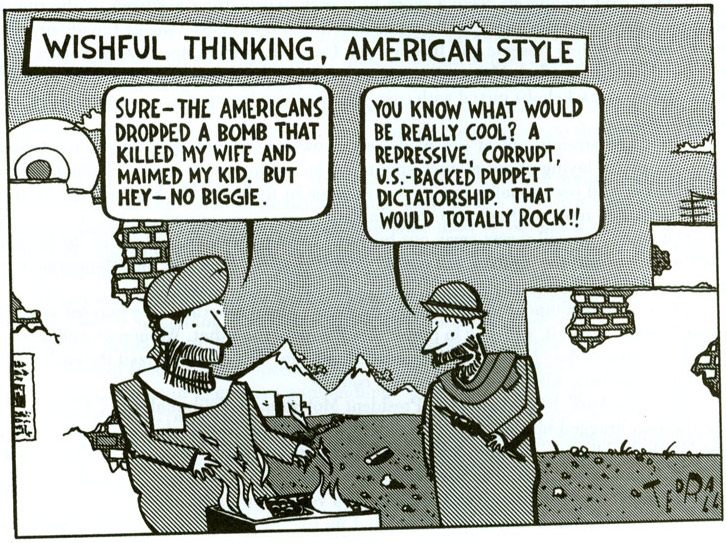
The Eleven Year War (Afghanistan and Back by Ted Rall)


I woke up today to another story about a suicide attack in Afghanistan. It seemed that for at least a few precious weeks we had had little news from that region, a cutoff in the steady stream of news about political reverses and Shia pilgrims under attack and suicide bombers. Coverage was dominated by a bombshell of another nature, the Petraeus mistress scandal, as well as speculation about the possible compromising of sensitive information and the peddling of influence on the part of a wealthy Florida socialite. It was news that was predicated on scandal-mongering, with the whole East Coast news media set to twittering.

But then we were reminded of how volatile this region is, and of how the whole crisis mentality fits conveniently into the scheme of international coverage of the area. The whole Hamas-Israel confrontation captured the headlines, and we were treated to reports of bombing campaigns in Gaza and terrorist attacks in Israeli cities. I have to admit that I have long grown weary of this situation, and the prospect of protracted conflicts with both sides dug in deeper than ever, and with our country having to take a mediating role. In a sense, we must also signal out our news coverage for falling into an eternal crisis mode in which the same images of bombs and bloodshed is eternally circulated, but in which little though is given to trying to explain the complex circumstances behind these conflicts. There are reasons, after all, and they don’t evolve into the traditional “East is East and West is West” mentality that seemed to somehow justify 19th century western colonialism.

A few weeks ago I read Ted Rall’s “To Afghanistan and Back”. It is a chronicle of his journey to the country in 2001, told in the form of short prose narratives that are interspersed with graphical narratives that at times illustrate these episodes. The style is editorial, with people and places rendered in a simplistic style that seems a little crude at times. The figures are wooden and seem strangely static, conveying an old-fashioned sense that seems very unadorned, as if it were somehow more direct. It is at odds at times with the emotional intensity and the anxiety it wishes to portray, as bomb blasts echo in panels and as the journalist is forced to deal with a people who seem to obfuscate and hide their true selves.

In the opening moment of America’s intervention in Afghanistan, which was undertaken with the aim of toppling the Taliban regime and responding to the Sept. 11th events, we see an editorial journalist and part-time radio host who has joined a cadre of other journalists who swarmed into the country to capture the fall of the regime. First of all, one wonders at the foolhardiness of these journalists. They seem to absurdly believe that they will be somehow shielded from any harm by their profession, as if this aura (and their camera and reporting gear) could somehow stop bullets and protect them from exploding land mines and shrapnel from aerial bombing campaigns. They seem to be disconnected from their reality, and it echoes the criticism that had been lodged against CNN and their enterprising journalists way back in the early 90s, when they embedded their journalist in Baghdad and reported breathlessly on the explosions in their midst, a mindset that fetished explosions and rattling effects, as if feeding a video-game mentality.

Ted Rall is an editorial cartoonist whose work has frequently struck me for its smirking tone.  (He himself utilizes the adjective “snarky” in this book.) I had first heard about him when he was a radio host on local AM powerhouse station KFI, the most popular outlet in Southern California for extremist right-wing radio. He himself, however, was no right-winger, and seemed if anything to offer a contrarian opinion that was grounded in comedy, similar to John Stewart, and it was refreshing. It made his program at least somewhat palatable as Saturday night fare, for those of us who no longer venture out on dates nor wish to recapitulate the other frenetic rituals of our earlier adolescence.

One of the features of his program was a segment that he called the “’Stan Report”. No, it wasn’t a report on people named Stanley, but instead his reflections on the countries in the region of East Asian that end with the suffix “stan”. It is, as I understand it, a linguistic term that derives from Persian, and it refers, of course, to “land”. We know of many of these countries: Afghanistan, Pakistan, Tajikistan, Uzbekistan, Kazahkstan, etc. In the popular imagination, they all seem to merge together to give us the impression of unstable regions that are gripped by religious fundamentalism and a pervading medieval mentality.

That was certainly the impression that Ted Rall conveyed in his report, and one of the reasons why I grew tired of this segment. He may very well have journeyed to the area, but I questioned how much he could have gleaned from these journeys to be able to simplify and paint with such as broad stroke as he did. Was he not perhaps parodying the mindset of the right-wingers who held forth during the daylight hours on that station, the very same ones that he seemed to snipe at constantly at other moments? He seemed a little too earnest and dismissive in this segment, portraying a region that was somehow inoculated against change and modernity.

Well, after reading this narrative (which he terms a “graphic travelogue”), I think that he does carry a touch of what one could term an “Orientalist” perspective, to make reference to Edward Said’s classic volume on the ways in which western countries have elaborated an ideological scheme that served to demonize and distort our perception of the East. It does no credit to his journey that was supposedly motivated to offer a critique of the Bush doctrine of intervention and conquest. Was that the only motivation, or was it not more self-serving?

I return, over and over, to consider this question and to what might have motivated this group of journalists to insert themselves in this region without recognizing the very real dangers to which they were exposing themselves. They arrived in caravans traveling through difficult terrain, with heavy equipment and enterprising mentalities, hoping to catch crucial footage of historical events but also, one suspects, wishing to burnish their reputations and feed a seemingly infinite western appetite for gore and drama on a public that had been feeling anxiety about this region. They were looking for drama and heroism and other saleable commodities as they narrated the pitched battles between the Northern Alliance and the Taliban remnants, but it wasn’t that easy. They were, of course, woefully unprepared for what they encountered, and what is more shameful, oblivious to their surroundings.

They arrived with little knowledge of the country and even less of the language. How did they expect to carry through with their mission? I am struck over and over by how this collection of international journalists stuck to themselves, dependent upon each other for rumors and tips and forced to rely on translators they seemed to distrust and resent because of their predatory instincts. How accurate were these translators, and how could they be sure about the stories they were being fed? They were certainly greedy, demanding $150 per day in fees when, as Rall repeats over and over, the average month wage was $1.40. There was some serious price-gouging goingn on, but I can’t blame them.

Try to look at it from their point of view. Who are these western journalists who so callously descend on the region, accompanying the vanguard of an invasion force that indiscriminately bombs their towns and villages from above, supporting an opposition movement (the Northern Alliance) that presents itself as a viable and modern alternative to the Taliban regime but that reveals itself to be a paragon of corruption, venality and sheer stupidity? These western journalists are the vanguard of western soldiers and western policymakers who seem to be similarly clueless, and they must be viewed as similarly suspect by the Afghan population. If they were taken advantage of and if they were given boiled sewer water instead of clean water from a well, or charged $800 for a twenty mile taxi ride, was this not a way of merely reflecting the greed and the self-interest they themselves revealed? Does this make the Afghans more “medieval”, a term used by Rall when describing the scenes he encountered in the country, knowing full well that the very use of the term brings up associations in our minds that are unfailingly negative because they are based on a construct that wishes to impose western historical experience on a wholly different region?

I hate to say it, but I felt little sympathy for the hardship that was suffered by Rall and his fellow collection of motley journalists while carrying out this supposed mission. (Yes, there is a strong sense of suspicion as to their real intentions, at least as presented by Rall.) We are treated to descriptions of flea-infested rugs and rickety buildings, of venal Alliance commanders, of hypocritical and two-faced Taliban soldiers who shave off their beards and buy Tajik hats in order to switch sides when it seems as if they are about to be overwhelmed, and then take up arms again against the Northern Alliance solidiers they have joined, as has happened over and over ten years later, in the spate of attacks by Afghan soldiers against their NATO colleagues. Yes, there would seem to be a deep cultural disconnect taking place, but the dismissive attitude and the failure of Rall to attempt to address and explain it would seem to underscore the continued influence of a colonial mentality. Things don’t change, despite eleven years of war in this country.

Yes, the mission was ill-conceived, and yes, I agree with Rall, the region harbors potentially vast reserves of petrochemical and mineral resources that western countries would love to exploit if they could only install convenient and complaint puppet regimes. Yes, I understand that Afghanistan is a crucial piece in this scheme, and that if it could be somehow pacified, a pipeline could be constructed through the country and into Pakistan, providing a new source of oil as well as hopefully providing a way to stabilize unstable regimes and destabilize stable regimes, by which I am referring respectively to Pakistan and Iran. Of course, oil resources have a tendency of serving only limited sectors, mainly, local economic elites as well as transnational corporations, and rarely have they led to sustained national development. Witness the case with countries such as Azerbaijan, Equatorial Guinea and Nigeria.  

So we have a mission in which Rall and his fellow journalist try to follow a shifting front, besieged as they are by predatory Afghanis who take to murdering them as related in the episode of the Swedish cameraman Ulf Stromberg, the only unfortunate westerner to open the door when soldiers knocked late at night at their compound. Yes, it is dangerous, but in the same way the situation is logical. To criticize bands of Afghanis for organizing these campaigns and for expressing their distrust of the westerners in their midst who descend and evaporate regularly like the winter snows is to fail to see that they have their own interests to address.

In the end, the portrayal of the Afghanis and of the difficulties encountered by Rall as he was engaged in this journalistic “stunt” (and we can’t label it as anything other than a “stunt”, for it was predicated on his own ignorance of the region and his failure to overcome his own prejudices and to question his own roll as he and his companions sought to score the latest “scoop”) tends to overshadow the critique of western interventionism. To boil it down, he is guilty of the same, part of the apparatus of western imperial dominance that is predicated on a certain predatory scheme that he excoriates when he sees it in operation among ordinary Afghans.  It lends itself to a corrosive discourse that discredits these people in a wholesale fashion, and the tedium he expresses sounds like the juvenile rant of a journalist who was unfamiliar with the ideals of his profession.


What is the purpose of allowing these journalists to descend en masse in these areas, as part of the vanguard of an invading western army?  Are they there only to lend a thin veneer of fairness and supposed transparency, to say that at least the West as an open society is prepared to accommodate a cadre of potential critics, even when these critics differ in no real way in their mindset from the elites who control the course of this foreign policy? Yes, I agree with Rall that the Northern Alliance is another fabricated opposition force, one that was a convenient front to carry forth this mission, making it seem as if opposition was internal, but are they as journalist in any way different?

I can’t see myself visiting any of the ‘Stans in the future, but if I do, I will have to be honest about my own preconceptions. At least Rall was honest about his, although I’m not sure if he understands the implications of this, and his snide criticisms of the region and its people seem to have ended up assuming a harder edge at the end of this travelogue.

The war in Afghanistan will undoubtedly continue for the foreseeable future, even though the United States is committed to withdrawing its forces in 2014. Perhaps it will be left for the surrounding countries to intervene and impose their own arrangement, as they had done before with Pakistan having imposed the Taliban after the period of Soviet intervention. This has been the longest war in American history, and also, the most pointless.


Eternal Observer -- ORomero (c) 2013
Copyrights ORomero 2013
Thursday, November 22, 2012

Review of "Which Way Home"


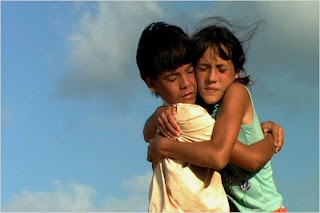
“Which Way Home” is a documentary directed and produced by Rebecca Cammisa that deals with the plight of migrant children as they make their journey to the United States. The phenomenon is by no means recent, and is as old as the epic of migration. It is colored by the pain of separation, and the deep feeling of abandonment that leads to guilt on the part of parents and deep feelings of inadequacy that can lead to bitterness on the part of the children. The director includes interviews with the children, but what makes it novel is the fact that this documentary is also structured as an adventure story.

In this film we follow the journey of two migrant children from Central America. They are Kevin and Fito, and they are from a small town in Honduras. They seem to be undertaking the journey in good spirits, and seem fully as boisterous and optimistic as any children their age would be, undaunted as they are by the risks they have assumed. There is no doubt that this is a perilous journey, one that involves passage on top of the notorious “Bestia”, the name that has been given to the freight trains in Mexico that travel the length of Mexico.

This “Bestia” has become part of the mythology of migration for many. These trains leave from the border region with Guatemala, and they are infused with a sense not only of hope but also dread. One imagines that trains were similarly viewed here in the United States in an earlier epoch of our history, when the movement west was one that represented, as the movement north to the United States does to these migrants, a hope for a new beginning.

However, along with the hope comes the prospect as well of danger and threats. It is a perilous journey in which many migrants struggle to climb aboard and hold on. The viewer has a visceral sense of these threats in the way in which these people scramble to hold on to the sides of moving trains, and climb aboard them and are forced to be on the watch for vegetation such as the branches of trees that threaten to knock them off. There are also, of course, the unexpected starts and stops of the trains that seem to snort and buckle the way a horse does, thus helping to explain the alternate name “Caballo” .

The human danger is just as prevalent, although one can earnestly believe that the presence of a camera crew worked to afford these children a protective shell. For other migrants, there is always the prospect of encounters with thieves and sexual predators, and indeed, many migrants lose everything long before they reach the border. It is a perilous journey, one that would seem terrifying to an adult but that somehow seems unreal to the children.

Kevin and Fito at times play up to the camera. It is unsettling to see them clinging to a side hold on the train as it passes over steep hillsides, and to see them nonchalantly approaching Mexican families to beg for food to eat. It is an adventure for them, and they open up to the camera crew, confessing quite candidly that their motivation resides not only in a wish for reunification with a missing parent, but also, from dysfunctional family dynamics. They both confess to having felt rejected by their parents, and in a way this journey is an escape that is part of a painful process of adolescent crisis.

The journey is long, and we are left to wonder how far they will reach. It seems even from the beginning that they are living on borrowed time, and this helps to create a sense of latent danger. How far will they get, and is there tragedy awaiting them?  Given the way in which they have built up the American Dream and their eager wish for accepting families and material comfort, is seems that their wishes inevitably will be dashed, for how can reality hope to measure up?

After a series of rendezvous, the camera crew loses track of the children, only to find them again at a later moment.  The worst has not happened. Kevin, the chubby and ebullient youngster who seemed to be the leader of this group that came to include as well two Mexican boys (Jairo and the “Dog”), manages to make it to the border and turns himself in. Fito somehow makes it back without reaching the border. The “Dog”, sadly, returns to Chiapas and picks up his prior lifestyle as a niño gamin, those that inhabit the streets and live by petty thievery and glue-sniffing.

The film, of course, touches upon the experience of other selected individuals. It is, of course, heart-breaking to see children who have been detained by immigration authorities, abandoned at times by their smugglers, and awaiting repatriation to families that, in a real sense, have no place for them. Migration has become a safety-valve not only for economic migrants but for those whose problems derive from psycho-social circumstances, and we can’t underestimate the degree to which spiritual poverty, for lack of a more adequate term, leads to migration.

Both the children when repatriated as well as their parents are enjoined by the authorities to repair their own family relationships. It is, of course, evident to all to see that these reunions mask deeper problems. These children have, in a sense, already been abandoned, and it is only a matter of time before they leave on the eternal quest to start their own families, ones that will offer them the emotional support that they receive , for example, from the film crews that followed and interviewed them, shielding them from the worse aspects of this journey to the north.

We have no firm statistics on the number of deaths, and one of the leaders of a refugee center in Mexico asserts that between 10 and 20 percent of migrants will perish on this journey north. He earnestly warms them that if this journey is a dangerous passage, then the North, “El norte”, is death itself. It is a dramatic warning, and none of the migrants is quite prepared to understand what it will mean to run the risk of being kidnapped by drug gangs, as happens frequently, and possibly massacred, or to run the risk of crossing a dangerous desert. What do they know of deserts, they who come from tropic homelands?

In the end, Kevin does make a second journey, and he does end up in Washington, wishing, as the film informs us, to be adopted by an American family. Where, indeed, is he to find his home? It isn’t in the countries he left behind.  And that is one of the psychological effects of migration, for the journey itself and the illusion of the “dream” unsettles them, perhaps permanently.  It is to be expected that it will serve as the groundwork for a powerful nostalgia that will affect them the way it affects all of us as we grow older, for we never stop believing in the power of illusions.


Eternal Observer -- ORomero (c) 2013
Copyrights ORomero 2013

Sunday, November 4, 2012

Election Overload


Finally, two days before Election Day, after months and months of news coverage, of political speeches, of news “bites” recycled over and over, of ambushes and sorties and accusations that verge on the ridiculous, as exemplified in particular by the PAC ads running in Ohio during the last week. We’ve had attack heaped on attack, with politicians earnestly exhorting the public to “read my plan” while offering precious few details a la Romney’s budget, and we’ve had endless political punditry that has left me more disillusioned precisely because it seems to concentrate, as always, on style rather than substance. It is hard not to compare this campaign to the recent hurricane Sandy that devastated the East Coast last week. Both have been incredibly destructive forces that have swept everything away in their sights, that have terrorized the population of that region and that will leave a legacy of finger-pointing as we reflect on the work that will be done to repair all the damage. And as with all natural disasters, we have the inevitability of the next one that is coming down the line.

I would like to believe that there used to be a time when campaign season was more joyous and innocent, when politicians weren’t beholding to fundraisers and political campaign contributions, when earnest people were willing to represent their communities with a spirit of moderation. Was it ever the case? When did we devolve into this madness we see every four years, a grinding process that tears away at us inside and that leaves us more dispirited than we ever were? Why do we lament over and over the way we have been consumed by partisanship, manipulated as we are by agents that claim to represent us but are instead representing their own interests? Is it only that these agents are freer now to reveal themselves and to shower their cash without restraint or oversight? Why has this election season alarmed me as never before?

It isn’t enough to the gridlock on Capital Hill. I can’t hear another ridiculous accusation by extremists firebrands such Michelle Bachmann or social conservatives such as the Missouri Senate candidate who earnestly proclaimed the idea of “legitimate rape” without wondering how they haven’t been hounded out of politics by reasonable people. The extremists are feeling freer than ever to proclaim their messages, doing so with a messianic zeal that seduces so many who are taken in by the proclamation of conviction rather than by the thoughtful consideration of the ideas. That is precisely what we are seeing as well with the political attack ads, and the way they formulate new and emotionally-appealing attacks that have no foundation in truth and that instead rely on distortion.

Nowadays, I have this strong sense that our political parties don’t represent my interests. They resort to the same formulas we’ve seen earlier, but delivered in wittier fashion and with a sense of urgency that seeks to bypass reason. For decades the Republicans have been relying on a standard attack on “Big Government”, while at the same time hypocritically increasing expenditures and yoking it to an invasive program of social conservatism that threatens to control how we conduct our lives at home. It is a deadly attack, and the Democrats never seem able to mount a convincing counterattack. They look muddled in response, reasonable, using charts and figures to counteract this attack when it is rhetoric and not charts that win the day. Neither party addresses the full panoply of concerns that I have, because they are limited to reprise this cycle of attack and counter-attack, in the mode of “Spy versus Spy” in the old Mad magazine serial.

Instead of a profuse Baroque symphony we have instead the same insistent notes jabbed over and over and over again. The claim is made that we are experiencing a crisis that threatens to overwhelm us unless we take dramatic action now. It all depends on scaring us, and of invoking what would seem to be our deepest fears. Who can live under the suffocating mantle of crisis? Is it not a mind scheme that is designed to alarm and provoke us into mindless action? Will we not always regret these actions taken in haste and without thoughtful consideration as we do the crash after a night of binge drinking? It is a form of intoxication that weaves the fumes of fear and propels us into the darkness with a lamp, and it is one that is used by both parties, although much more insistently and expertly by the Republicans. It has become, after all, their mainstay.

I refuse to be considered as just another mobile soldier to be rushed to the front. Everyone is appealing to me to save the day, to get out and make a difference, to fight for the future, and for any number of other clichés. We are in crisis, and we have to put up with what seems to be a never-ending barrage of ads and soundbites and rhetorical flourishes that suck the oxygen from our air and poison us against each other. I have political views and values, but I hate to be so blatantly manipulated.

My values are progressive, but I have a practical streak. I don’t appreciate this blind partisanship, and I don’t want conservative sectors to impose their rigid social values on me. It is hard enough to escape the confines of religious custom and that scheme of fundamentalism that purports to be based on true values that, in Mike Huckabee’s repressive phrase, stand “The test of fire”. I can’t believe in such a diety, for what is hell but another rhetorical excess? Are things so stark that we can only imagine this opposition between black and white, between pure good and pure evil? Why does this puritanical religious fundamentalism seem to pervade our politics more and more, yoked as it is with an anti-science bias as seen in the Republican agenda that wishes to inveigh against evolution and climate-change?

We knew it was going to be a bruising fight before the beginning of this campaign season. It seems as if the previous campaign season had not ended before we were gearing up for a new tsunami of attacks, and perhaps that is what it means to live in this current political climate. The election season is never over, and as with house races where representatives spend more time fundraising and working to hold on to their seats than they do crafting policies, we are constrained by our voracious election cycles.

We knew enough to expect tactics similar to the scurrilous “Swift-Boat” attack shamelessly pioneered by political operative Karl Rove eight years ago. We knew that PACs would have a more prominent role than ever, for they were unleashed by the “Citizen’s United” Supreme Court decision as a seeming reaffirmation of free speech protections. To have eliminated those restrictions to unregulated contributions by corporations was to create the conditions for the exhausting and hyperbolic campaign we have just witnessed, where by one report over six billion will have been spent.

So, in these last two days, after what seems like a decade of campaigning, with both sides still delivering nonstop attacks, I can’t help but miss what I would like to believe were the more placid campaigns of the past. I was a child during the Watergate years, and I don’t really have a sense of how gut-wrenching an experience that might have been to adults during that era, except by recalling the Iran-Contra hearings that took place during the last year of Reagan’s presidency. Was it similar in overall impact? Probably not. I have heard again and again in interviews with politicians from the 70s and 80s about how there used to be a different culture in Congress. They used to be able to set aside ideological baggage to adopt a more practical and reasoned approach. Perhaps it is just me expressing my cynicism by refusing to believe in this fallacy of a golden age although I very much want to believe in it. Perhaps twenty years down the line we will have House representatives sponsored by Exxon or Koch Industries or Walmart and we will look back on this season with wistfulness.

I fear a Romney win. I fear it, because I believe it would affirm the fundamentalism of the extremist conservative forces that are beholden to corporate interests, those who would like to appeal to the defense of meritocracy when all we have seen with them is that they are just as capable of ruinous policies and failure as another other group. They were behind the banking crash of 2008. They are behind the outsourcing of jobs, and environmental cataclysms, and yet, when those executives fail, they are prosecuted, they leave with golden parachutes that take the form of multi-million dollar payouts.

These extremist ideologists continually appeal to fear, and it is shameful to say it, have struck an echoing chord among white working classes who are willing to believe their message that they would fear the control of elites while hypocritically deflecting any attention to themselves. These forces have also highjacked the Democratic party apparatus as well, and that is what worries me, that I have no viable political options, and that I am left to vote for the lesser of two evils.

The election will soon be over, and we won’t have this barrage of coverage on the news channels anymore. It will blissfully come to an end, even if only for a nanosecond, a brief pause before we gear up for the next election cycle that looms on the horizon like a troubling storm. Although the overall problems and concerns will continue to demand solutions, at least we will be spared and left to try to survey and clean up the damage, and maybe, just maybe, to restore power and enjoy a little brief flash of light. I just want this cycle of endless campaigns to end.  We are not in a crisis, but we do have problems, and I at least wish to be demobilized from this need to partake in an endless political campaign season.


Eternal Observer -- ORomero (c) 2013
Copyrights ORomero 2013