Friday, November 23, 2012

The Eleven Year War (Afghanistan and Back by Ted Rall)


I woke up today to another story about a suicide attack in Afghanistan. It seemed that for at least a few precious weeks we had had little news from that region, a cutoff in the steady stream of news about political reverses and Shia pilgrims under attack and suicide bombers. Coverage was dominated by a bombshell of another nature, the Petraeus mistress scandal, as well as speculation about the possible compromising of sensitive information and the peddling of influence on the part of a wealthy Florida socialite. It was news that was predicated on scandal-mongering, with the whole East Coast news media set to twittering.

But then we were reminded of how volatile this region is, and of how the whole crisis mentality fits conveniently into the scheme of international coverage of the area. The whole Hamas-Israel confrontation captured the headlines, and we were treated to reports of bombing campaigns in Gaza and terrorist attacks in Israeli cities. I have to admit that I have long grown weary of this situation, and the prospect of protracted conflicts with both sides dug in deeper than ever, and with our country having to take a mediating role. In a sense, we must also signal out our news coverage for falling into an eternal crisis mode in which the same images of bombs and bloodshed is eternally circulated, but in which little though is given to trying to explain the complex circumstances behind these conflicts. There are reasons, after all, and they don’t evolve into the traditional “East is East and West is West” mentality that seemed to somehow justify 19th century western colonialism.

A few weeks ago I read Ted Rall’s “To Afghanistan and Back”. It is a chronicle of his journey to the country in 2001, told in the form of short prose narratives that are interspersed with graphical narratives that at times illustrate these episodes. The style is editorial, with people and places rendered in a simplistic style that seems a little crude at times. The figures are wooden and seem strangely static, conveying an old-fashioned sense that seems very unadorned, as if it were somehow more direct. It is at odds at times with the emotional intensity and the anxiety it wishes to portray, as bomb blasts echo in panels and as the journalist is forced to deal with a people who seem to obfuscate and hide their true selves.

In the opening moment of America’s intervention in Afghanistan, which was undertaken with the aim of toppling the Taliban regime and responding to the Sept. 11th events, we see an editorial journalist and part-time radio host who has joined a cadre of other journalists who swarmed into the country to capture the fall of the regime. First of all, one wonders at the foolhardiness of these journalists. They seem to absurdly believe that they will be somehow shielded from any harm by their profession, as if this aura (and their camera and reporting gear) could somehow stop bullets and protect them from exploding land mines and shrapnel from aerial bombing campaigns. They seem to be disconnected from their reality, and it echoes the criticism that had been lodged against CNN and their enterprising journalists way back in the early 90s, when they embedded their journalist in Baghdad and reported breathlessly on the explosions in their midst, a mindset that fetished explosions and rattling effects, as if feeding a video-game mentality.

Ted Rall is an editorial cartoonist whose work has frequently struck me for its smirking tone.  (He himself utilizes the adjective “snarky” in this book.) I had first heard about him when he was a radio host on local AM powerhouse station KFI, the most popular outlet in Southern California for extremist right-wing radio. He himself, however, was no right-winger, and seemed if anything to offer a contrarian opinion that was grounded in comedy, similar to John Stewart, and it was refreshing. It made his program at least somewhat palatable as Saturday night fare, for those of us who no longer venture out on dates nor wish to recapitulate the other frenetic rituals of our earlier adolescence.

One of the features of his program was a segment that he called the “’Stan Report”. No, it wasn’t a report on people named Stanley, but instead his reflections on the countries in the region of East Asian that end with the suffix “stan”. It is, as I understand it, a linguistic term that derives from Persian, and it refers, of course, to “land”. We know of many of these countries: Afghanistan, Pakistan, Tajikistan, Uzbekistan, Kazahkstan, etc. In the popular imagination, they all seem to merge together to give us the impression of unstable regions that are gripped by religious fundamentalism and a pervading medieval mentality.

That was certainly the impression that Ted Rall conveyed in his report, and one of the reasons why I grew tired of this segment. He may very well have journeyed to the area, but I questioned how much he could have gleaned from these journeys to be able to simplify and paint with such as broad stroke as he did. Was he not perhaps parodying the mindset of the right-wingers who held forth during the daylight hours on that station, the very same ones that he seemed to snipe at constantly at other moments? He seemed a little too earnest and dismissive in this segment, portraying a region that was somehow inoculated against change and modernity.

Well, after reading this narrative (which he terms a “graphic travelogue”), I think that he does carry a touch of what one could term an “Orientalist” perspective, to make reference to Edward Said’s classic volume on the ways in which western countries have elaborated an ideological scheme that served to demonize and distort our perception of the East. It does no credit to his journey that was supposedly motivated to offer a critique of the Bush doctrine of intervention and conquest. Was that the only motivation, or was it not more self-serving?

I return, over and over, to consider this question and to what might have motivated this group of journalists to insert themselves in this region without recognizing the very real dangers to which they were exposing themselves. They arrived in caravans traveling through difficult terrain, with heavy equipment and enterprising mentalities, hoping to catch crucial footage of historical events but also, one suspects, wishing to burnish their reputations and feed a seemingly infinite western appetite for gore and drama on a public that had been feeling anxiety about this region. They were looking for drama and heroism and other saleable commodities as they narrated the pitched battles between the Northern Alliance and the Taliban remnants, but it wasn’t that easy. They were, of course, woefully unprepared for what they encountered, and what is more shameful, oblivious to their surroundings.

They arrived with little knowledge of the country and even less of the language. How did they expect to carry through with their mission? I am struck over and over by how this collection of international journalists stuck to themselves, dependent upon each other for rumors and tips and forced to rely on translators they seemed to distrust and resent because of their predatory instincts. How accurate were these translators, and how could they be sure about the stories they were being fed? They were certainly greedy, demanding $150 per day in fees when, as Rall repeats over and over, the average month wage was $1.40. There was some serious price-gouging goingn on, but I can’t blame them.

Try to look at it from their point of view. Who are these western journalists who so callously descend on the region, accompanying the vanguard of an invasion force that indiscriminately bombs their towns and villages from above, supporting an opposition movement (the Northern Alliance) that presents itself as a viable and modern alternative to the Taliban regime but that reveals itself to be a paragon of corruption, venality and sheer stupidity? These western journalists are the vanguard of western soldiers and western policymakers who seem to be similarly clueless, and they must be viewed as similarly suspect by the Afghan population. If they were taken advantage of and if they were given boiled sewer water instead of clean water from a well, or charged $800 for a twenty mile taxi ride, was this not a way of merely reflecting the greed and the self-interest they themselves revealed? Does this make the Afghans more “medieval”, a term used by Rall when describing the scenes he encountered in the country, knowing full well that the very use of the term brings up associations in our minds that are unfailingly negative because they are based on a construct that wishes to impose western historical experience on a wholly different region?

I hate to say it, but I felt little sympathy for the hardship that was suffered by Rall and his fellow collection of motley journalists while carrying out this supposed mission. (Yes, there is a strong sense of suspicion as to their real intentions, at least as presented by Rall.) We are treated to descriptions of flea-infested rugs and rickety buildings, of venal Alliance commanders, of hypocritical and two-faced Taliban soldiers who shave off their beards and buy Tajik hats in order to switch sides when it seems as if they are about to be overwhelmed, and then take up arms again against the Northern Alliance solidiers they have joined, as has happened over and over ten years later, in the spate of attacks by Afghan soldiers against their NATO colleagues. Yes, there would seem to be a deep cultural disconnect taking place, but the dismissive attitude and the failure of Rall to attempt to address and explain it would seem to underscore the continued influence of a colonial mentality. Things don’t change, despite eleven years of war in this country.

Yes, the mission was ill-conceived, and yes, I agree with Rall, the region harbors potentially vast reserves of petrochemical and mineral resources that western countries would love to exploit if they could only install convenient and complaint puppet regimes. Yes, I understand that Afghanistan is a crucial piece in this scheme, and that if it could be somehow pacified, a pipeline could be constructed through the country and into Pakistan, providing a new source of oil as well as hopefully providing a way to stabilize unstable regimes and destabilize stable regimes, by which I am referring respectively to Pakistan and Iran. Of course, oil resources have a tendency of serving only limited sectors, mainly, local economic elites as well as transnational corporations, and rarely have they led to sustained national development. Witness the case with countries such as Azerbaijan, Equatorial Guinea and Nigeria.  

So we have a mission in which Rall and his fellow journalist try to follow a shifting front, besieged as they are by predatory Afghanis who take to murdering them as related in the episode of the Swedish cameraman Ulf Stromberg, the only unfortunate westerner to open the door when soldiers knocked late at night at their compound. Yes, it is dangerous, but in the same way the situation is logical. To criticize bands of Afghanis for organizing these campaigns and for expressing their distrust of the westerners in their midst who descend and evaporate regularly like the winter snows is to fail to see that they have their own interests to address.

In the end, the portrayal of the Afghanis and of the difficulties encountered by Rall as he was engaged in this journalistic “stunt” (and we can’t label it as anything other than a “stunt”, for it was predicated on his own ignorance of the region and his failure to overcome his own prejudices and to question his own roll as he and his companions sought to score the latest “scoop”) tends to overshadow the critique of western interventionism. To boil it down, he is guilty of the same, part of the apparatus of western imperial dominance that is predicated on a certain predatory scheme that he excoriates when he sees it in operation among ordinary Afghans.  It lends itself to a corrosive discourse that discredits these people in a wholesale fashion, and the tedium he expresses sounds like the juvenile rant of a journalist who was unfamiliar with the ideals of his profession.
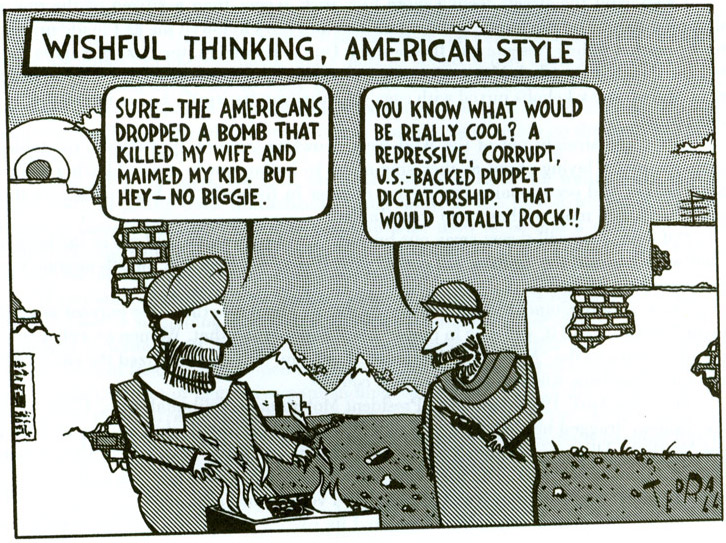

What is the purpose of allowing these journalists to descend en masse in these areas, as part of the vanguard of an invading western army?  Are they there only to lend a thin veneer of fairness and supposed transparency, to say that at least the West as an open society is prepared to accommodate a cadre of potential critics, even when these critics differ in no real way in their mindset from the elites who control the course of this foreign policy? Yes, I agree with Rall that the Northern Alliance is another fabricated opposition force, one that was a convenient front to carry forth this mission, making it seem as if opposition was internal, but are they as journalist in any way different?

I can’t see myself visiting any of the ‘Stans in the future, but if I do, I will have to be honest about my own preconceptions. At least Rall was honest about his, although I’m not sure if he understands the implications of this, and his snide criticisms of the region and its people seem to have ended up assuming a harder edge at the end of this travelogue.

The war in Afghanistan will undoubtedly continue for the foreseeable future, even though the United States is committed to withdrawing its forces in 2014. Perhaps it will be left for the surrounding countries to intervene and impose their own arrangement, as they had done before with Pakistan having imposed the Taliban after the period of Soviet intervention. This has been the longest war in American history, and also, the most pointless.


Eternal Observer -- ORomero (c) 2013
Copyrights ORomero 2013

Thursday, November 22, 2012

Review of "Which Way Home"


“Which Way Home” is a documentary directed and produced by Rebecca Cammisa that deals with the plight of migrant children as they make their journey to the United States. The phenomenon is by no means recent, and is as old as the epic of migration. It is colored by the pain of separation, and the deep feeling of abandonment that leads to guilt on the part of parents and deep feelings of inadequacy that can lead to bitterness on the part of the children. The director includes interviews with the children, but what makes it novel is the fact that this documentary is also structured as an adventure story.

In this film we follow the journey of two migrant children from Central America. They are Kevin and Fito, and they are from a small town in Honduras. They seem to be undertaking the journey in good spirits, and seem fully as boisterous and optimistic as any children their age would be, undaunted as they are by the risks they have assumed. There is no doubt that this is a perilous journey, one that involves passage on top of the notorious “Bestia”, the name that has been given to the freight trains in Mexico that travel the length of Mexico.

This “Bestia” has become part of the mythology of migration for many. These trains leave from the border region with Guatemala, and they are infused with a sense not only of hope but also dread. One imagines that trains were similarly viewed here in the United States in an earlier epoch of our history, when the movement west was one that represented, as the movement north to the United States does to these migrants, a hope for a new beginning.

However, along with the hope comes the prospect as well of danger and threats. It is a perilous journey in which many migrants struggle to climb aboard and hold on. The viewer has a visceral sense of these threats in the way in which these people scramble to hold on to the sides of moving trains, and climb aboard them and are forced to be on the watch for vegetation such as the branches of trees that threaten to knock them off. There are also, of course, the unexpected starts and stops of the trains that seem to snort and buckle the way a horse does, thus helping to explain the alternate name “Caballo” .

The human danger is just as prevalent, although one can earnestly believe that the presence of a camera crew worked to afford these children a protective shell. For other migrants, there is always the prospect of encounters with thieves and sexual predators, and indeed, many migrants lose everything long before they reach the border. It is a perilous journey, one that would seem terrifying to an adult but that somehow seems unreal to the children.

Kevin and Fito at times play up to the camera. It is unsettling to see them clinging to a side hold on the train as it passes over steep hillsides, and to see them nonchalantly approaching Mexican families to beg for food to eat. It is an adventure for them, and they open up to the camera crew, confessing quite candidly that their motivation resides not only in a wish for reunification with a missing parent, but also, from dysfunctional family dynamics. They both confess to having felt rejected by their parents, and in a way this journey is an escape that is part of a painful process of adolescent crisis.

The journey is long, and we are left to wonder how far they will reach. It seems even from the beginning that they are living on borrowed time, and this helps to create a sense of latent danger. How far will they get, and is there tragedy awaiting them?  Given the way in which they have built up the American Dream and their eager wish for accepting families and material comfort, is seems that their wishes inevitably will be dashed, for how can reality hope to measure up?

After a series of rendezvous, the camera crew loses track of the children, only to find them again at a later moment.  The worst has not happened. Kevin, the chubby and ebullient youngster who seemed to be the leader of this group that came to include as well two Mexican boys (Jairo and the “Dog”), manages to make it to the border and turns himself in. Fito somehow makes it back without reaching the border. The “Dog”, sadly, returns to Chiapas and picks up his prior lifestyle as a niño gamin, those that inhabit the streets and live by petty thievery and glue-sniffing.

The film, of course, touches upon the experience of other selected individuals. It is, of course, heart-breaking to see children who have been detained by immigration authorities, abandoned at times by their smugglers, and awaiting repatriation to families that, in a real sense, have no place for them. Migration has become a safety-valve not only for economic migrants but for those whose problems derive from psycho-social circumstances, and we can’t underestimate the degree to which spiritual poverty, for lack of a more adequate term, leads to migration.

Both the children when repatriated as well as their parents are enjoined by the authorities to repair their own family relationships. It is, of course, evident to all to see that these reunions mask deeper problems. These children have, in a sense, already been abandoned, and it is only a matter of time before they leave on the eternal quest to start their own families, ones that will offer them the emotional support that they receive , for example, from the film crews that followed and interviewed them, shielding them from the worse aspects of this journey to the north.

We have no firm statistics on the number of deaths, and one of the leaders of a refugee center in Mexico asserts that between 10 and 20 percent of migrants will perish on this journey north. He earnestly warms them that if this journey is a dangerous passage, then the North, “El norte”, is death itself. It is a dramatic warning, and none of the migrants is quite prepared to understand what it will mean to run the risk of being kidnapped by drug gangs, as happens frequently, and possibly massacred, or to run the risk of crossing a dangerous desert. What do they know of deserts, they who come from tropic homelands?

In the end, Kevin does make a second journey, and he does end up in Washington, wishing, as the film informs us, to be adopted by an American family. Where, indeed, is he to find his home? It isn’t in the countries he left behind.  And that is one of the psychological effects of migration, for the journey itself and the illusion of the “dream” unsettles them, perhaps permanently.  It is to be expected that it will serve as the groundwork for a powerful nostalgia that will affect them the way it affects all of us as we grow older, for we never stop believing in the power of illusions.


Eternal Observer -- ORomero (c) 2013
Copyrights ORomero 2013

Sunday, November 4, 2012

Election Overload


Finally, two days before Election Day, after months and months of news coverage, of political speeches, of news “bites” recycled over and over, of ambushes and sorties and accusations that verge on the ridiculous, as exemplified in particular by the PAC ads running in Ohio during the last week. We’ve had attack heaped on attack, with politicians earnestly exhorting the public to “read my plan” while offering precious few details a la Romney’s budget, and we’ve had endless political punditry that has left me more disillusioned precisely because it seems to concentrate, as always, on style rather than substance. It is hard not to compare this campaign to the recent hurricane Sandy that devastated the East Coast last week. Both have been incredibly destructive forces that have swept everything away in their sights, that have terrorized the population of that region and that will leave a legacy of finger-pointing as we reflect on the work that will be done to repair all the damage. And as with all natural disasters, we have the inevitability of the next one that is coming down the line.

I would like to believe that there used to be a time when campaign season was more joyous and innocent, when politicians weren’t beholding to fundraisers and political campaign contributions, when earnest people were willing to represent their communities with a spirit of moderation. Was it ever the case? When did we devolve into this madness we see every four years, a grinding process that tears away at us inside and that leaves us more dispirited than we ever were? Why do we lament over and over the way we have been consumed by partisanship, manipulated as we are by agents that claim to represent us but are instead representing their own interests? Is it only that these agents are freer now to reveal themselves and to shower their cash without restraint or oversight? Why has this election season alarmed me as never before?

It isn’t enough to the gridlock on Capital Hill. I can’t hear another ridiculous accusation by extremists firebrands such Michelle Bachmann or social conservatives such as the Missouri Senate candidate who earnestly proclaimed the idea of “legitimate rape” without wondering how they haven’t been hounded out of politics by reasonable people. The extremists are feeling freer than ever to proclaim their messages, doing so with a messianic zeal that seduces so many who are taken in by the proclamation of conviction rather than by the thoughtful consideration of the ideas. That is precisely what we are seeing as well with the political attack ads, and the way they formulate new and emotionally-appealing attacks that have no foundation in truth and that instead rely on distortion.

Nowadays, I have this strong sense that our political parties don’t represent my interests. They resort to the same formulas we’ve seen earlier, but delivered in wittier fashion and with a sense of urgency that seeks to bypass reason. For decades the Republicans have been relying on a standard attack on “Big Government”, while at the same time hypocritically increasing expenditures and yoking it to an invasive program of social conservatism that threatens to control how we conduct our lives at home. It is a deadly attack, and the Democrats never seem able to mount a convincing counterattack. They look muddled in response, reasonable, using charts and figures to counteract this attack when it is rhetoric and not charts that win the day. Neither party addresses the full panoply of concerns that I have, because they are limited to reprise this cycle of attack and counter-attack, in the mode of “Spy versus Spy” in the old Mad magazine serial.

Instead of a profuse Baroque symphony we have instead the same insistent notes jabbed over and over and over again. The claim is made that we are experiencing a crisis that threatens to overwhelm us unless we take dramatic action now. It all depends on scaring us, and of invoking what would seem to be our deepest fears. Who can live under the suffocating mantle of crisis? Is it not a mind scheme that is designed to alarm and provoke us into mindless action? Will we not always regret these actions taken in haste and without thoughtful consideration as we do the crash after a night of binge drinking? It is a form of intoxication that weaves the fumes of fear and propels us into the darkness with a lamp, and it is one that is used by both parties, although much more insistently and expertly by the Republicans. It has become, after all, their mainstay.

I refuse to be considered as just another mobile soldier to be rushed to the front. Everyone is appealing to me to save the day, to get out and make a difference, to fight for the future, and for any number of other clichés. We are in crisis, and we have to put up with what seems to be a never-ending barrage of ads and soundbites and rhetorical flourishes that suck the oxygen from our air and poison us against each other. I have political views and values, but I hate to be so blatantly manipulated.

My values are progressive, but I have a practical streak. I don’t appreciate this blind partisanship, and I don’t want conservative sectors to impose their rigid social values on me. It is hard enough to escape the confines of religious custom and that scheme of fundamentalism that purports to be based on true values that, in Mike Huckabee’s repressive phrase, stand “The test of fire”. I can’t believe in such a diety, for what is hell but another rhetorical excess? Are things so stark that we can only imagine this opposition between black and white, between pure good and pure evil? Why does this puritanical religious fundamentalism seem to pervade our politics more and more, yoked as it is with an anti-science bias as seen in the Republican agenda that wishes to inveigh against evolution and climate-change?

We knew it was going to be a bruising fight before the beginning of this campaign season. It seems as if the previous campaign season had not ended before we were gearing up for a new tsunami of attacks, and perhaps that is what it means to live in this current political climate. The election season is never over, and as with house races where representatives spend more time fundraising and working to hold on to their seats than they do crafting policies, we are constrained by our voracious election cycles.

We knew enough to expect tactics similar to the scurrilous “Swift-Boat” attack shamelessly pioneered by political operative Karl Rove eight years ago. We knew that PACs would have a more prominent role than ever, for they were unleashed by the “Citizen’s United” Supreme Court decision as a seeming reaffirmation of free speech protections. To have eliminated those restrictions to unregulated contributions by corporations was to create the conditions for the exhausting and hyperbolic campaign we have just witnessed, where by one report over six billion will have been spent.

So, in these last two days, after what seems like a decade of campaigning, with both sides still delivering nonstop attacks, I can’t help but miss what I would like to believe were the more placid campaigns of the past. I was a child during the Watergate years, and I don’t really have a sense of how gut-wrenching an experience that might have been to adults during that era, except by recalling the Iran-Contra hearings that took place during the last year of Reagan’s presidency. Was it similar in overall impact? Probably not. I have heard again and again in interviews with politicians from the 70s and 80s about how there used to be a different culture in Congress. They used to be able to set aside ideological baggage to adopt a more practical and reasoned approach. Perhaps it is just me expressing my cynicism by refusing to believe in this fallacy of a golden age although I very much want to believe in it. Perhaps twenty years down the line we will have House representatives sponsored by Exxon or Koch Industries or Walmart and we will look back on this season with wistfulness.

I fear a Romney win. I fear it, because I believe it would affirm the fundamentalism of the extremist conservative forces that are beholden to corporate interests, those who would like to appeal to the defense of meritocracy when all we have seen with them is that they are just as capable of ruinous policies and failure as another other group. They were behind the banking crash of 2008. They are behind the outsourcing of jobs, and environmental cataclysms, and yet, when those executives fail, they are prosecuted, they leave with golden parachutes that take the form of multi-million dollar payouts.

These extremist ideologists continually appeal to fear, and it is shameful to say it, have struck an echoing chord among white working classes who are willing to believe their message that they would fear the control of elites while hypocritically deflecting any attention to themselves. These forces have also highjacked the Democratic party apparatus as well, and that is what worries me, that I have no viable political options, and that I am left to vote for the lesser of two evils.

The election will soon be over, and we won’t have this barrage of coverage on the news channels anymore. It will blissfully come to an end, even if only for a nanosecond, a brief pause before we gear up for the next election cycle that looms on the horizon like a troubling storm. Although the overall problems and concerns will continue to demand solutions, at least we will be spared and left to try to survey and clean up the damage, and maybe, just maybe, to restore power and enjoy a little brief flash of light. I just want this cycle of endless campaigns to end.  We are not in a crisis, but we do have problems, and I at least wish to be demobilized from this need to partake in an endless political campaign season.


Eternal Observer -- ORomero (c) 2013
Copyrights ORomero 2013

Sunday, October 21, 2012

The Fixer by Joe Sacco

The Lies of Myth
A review of “The Fixer” by Joe Sacco


The work feels like an afterthought. It is more of a human interest story, one that relies primarily on character and the myths that emerge after historic episodes such as the Balkans wars of the early 1990s. It is not a novel that purports to explain this conflict, as with other works such as “Safe Area Gorazde” or “Palestine”, and doesn’t have share in the explanatory, journalistic style that we saw in these previous works. We relies, perhaps, too much on the charisma of the title character.

The title refers to a man named Nevin, who ostensibly hails from the state of Bosnia-Herzegovina and who fought against the Serbians despite the fact that his father was an ethnic Serbian. This is part of the mythology that is erected around this character, and is faithfully related by the author. We are never quite sure what to believe, and indeed, as the story proceeds, we are made privy to information which contradicts the claims made by this individual. And yet a compelling story trumps all, as is the case, during this election season of 2012, of the scurrilous attack ads that are crafted by political operatives and feature, as always, many distortions.

Neven served as a guide to the journalist, and we find frequently an inclination towards trust. This is, thus, an investigation of how the journalist can himself fall prey when he has little recourse to verification, and instead, decides to rely on what can only be a protective figure who offers a form of companionship that the journalist found immensely appealing.

It turns out that the character is a former soldier, and in the years after the Dayton accords that put an end to the Balkans conflict, he earns his post as an interpreter and guide as well as a go-between. His aid is much appreciated by Joe, even if it is immediately apparent that he is being used. This should have raised all manner of flags, and indeed it does, but the journalist chooses to ignore them, caught as he is in the web of the legend that is presented to him.

I wonder that Mr. Sacco chose to return again and again to the Balkans, and yet remained so manifestly helpless as to never be able to learn the language, even a few phrases, enough to  be able to understand the cost for the services being provided. He relies utterly on Nevin and on his subjects and informants, and is told how much to pay, how much to tip, etc. It must, indeed, be very bewildering to find oneself in such an environment, feeling totally helpless, and this explains in part the attraction of the companionship that is offered by this ex-soldier. He feels protected, he feels guided, and he exults in the aura of shared respectability because he sees that everyone seems to respect Nevin. It feels as if he is motivated by some deep insecurity, perhaps some form of psychological need that comes from the fact that the author is himself a foreigner, and furthermore, small and weak and lacking in charisma. (Mr. Sacco always insists on drawing himself in what seems to be a very unattractive way, with a fleshy and wide face and thick, protruding lips that resemble that of a fish out of water.)

He listens to the stories, to the mythology of the Bosnian military units that resisted the attacks of the nationalist Serbians (known derisively as “Chetniks”). There was something grand about them, although as his informant related to him, they almost always came from a background of petty theft and criminality, and some of them were known for their extreme violence and brutality. In these circumstances, in a cosmopolitan city such as Sarajevo, with a cowed population that lacked not only the means but the psychological willingness to accept their plight, it is not surprising that these figures seemed glamorous. Even if, at the same time, they were robbing the civilians of their food and shelter, and forcing them to dig trenches and thus courting a sure death, and raping and abusing women as they settled in to carve out their small kingdoms in this city under siege.

We thus hear of the two “Celas”, of Ismet Bajramovic and Ramiz Delalic, and of other warlords who are the protagonists of Nevin’s accounts of heroism, but also, have a shady side that of course can’t help but compromise Nevin as well. There was no high idealism in this military commanders, and if Nevin was their companion and brother in arms, are we not to question his own motives? Sacco seems to be aware of these contradictions, and as he finds out in his interviews with former government security ministers as well as journalists, almost everything that he has been told by Nevin seems to involve much fabrication. These were thugs, through and through, and yet, somehow, they were involved in the fight against the encircling Serb soldiers, and were the only line of defense in a period when the central Bosnian authority lacked the means to prepare their own soldiers. Sarajevo, quite manifestly, might have suffered what happened in the eastern regions of Bosnia-Herzegovina. It might also have been cleansed of all Bosniaks, and it might have been the sight of major massacres.

The warlords are guilty of their own massacres, as it becomes apparent. They may perhaps better be apprehended as a band of mercenaries serving under the command of their protective leaders, those who fed them and who acceded to some of their worst impulses. They had harems, they expelled Serbians and confiscated their homes and possessions, they robbed and looted, and yet, they were the only line of defense against the opposing forces that were arrayed against the city. They were glamorous Mafiosi with automatic rifles.

There is thus a whole list of heroic deeds that are related by Nevin, deeds that indeed seem to shape the stature of these figures. One such deed is the episode of how the soldiers managed to destroy several tanks that were being brought to bear against Sarajevo. A band of soldiers with rocket propelled grenades being able to stop tanks. Could it be any more implausible? And yet, Sacco wants to believe, and we want to believe also. We want stories of heroism and magnificent deeds, and we are hard-pressed to believe it when witnesses contradict these stories. Such, perhaps, were the exploits of all heroes magnified. Such, indeed, must have been what happened with El Cid, and with Almanzor, and with Roland, and with other epic figures. We want to believe in heroes, because this is fiction, and because it represents a reprieve from mundanity. And, all the while, we see how Nevin exploits the journalist, charging for his information and making him feel obligated.

In the epilogue, we see a warm reencounter between Sacco and Nevin. Of course, they have both aged. Nevin is not quite the heroic figure he was before, and the narrative weaves between different historical moments. The ex-soldier is now pudgy, and is furthermore ill, seeming to suffer from some sort of heart ailment that forces him to take medication on a regular basis. Might he have had a heart attack by now? Well, when you smoke as compulsively as he does (he is inhaling and exhaling smoke in almost every frame in which he is drawn), it is not surprising.

They fall back on their familiar patterns. Sacco needs Nevin, and Nevin needs him. The storyteller needs his audience, and the truth, as always, is hard to find. Maybe the reputation of those thugs who defended Sarajevo will be rehabilitated in the future, because the reputation was destroyed when the central government asserted control over these military figures. They were captured and neutralized, and many were killed. But any institution will need its own mythology, and the war is prime material, for it represents the moment for the foundation of the new state. It must be a grandiose occasion, unsullied by pettiness and larceny and murderous impulses. It must have its own George Washingtons, in other word, even if we must question to what extent the heroic perception of our own foundational figures is also a story.

So, the Celas are ripe to be reincorporated into the national mythology, more so since they have been killed and are not there to embarrass the authority figures. We will sweep aside the stories of their atrocities, for a nation needs heroes, in the same way that our Saccos need their Nevins, even if the last image we have is of a journalist who has become wistful as he considers how he himself has collaborated in the fabrication of a myth.

But it was a wonderful story. How is it that Nevin is still around?, wonders another of Sacco’s informants.  He had a reputation for being a brave fighter.

Myth has made him larger than life, and we yearn for myth and for heroes.


Eternal Observer -- ORomero (c) 2013
Copyrights ORomero 2013

Wednesday, October 17, 2012

Safe Area Gorazde by Joe Sacco


Cleansing the Soul of Loneliness:
A review of “Safe Area Gorazde” by Joe Sacco

 
In hindsight, it is never easy to justify the recourse to war. So much suffering, so much death and destruction, so much passion and anguish and manipulation all in the service of resolving conflicts and defending causes that hardly seem to justify the extraordinary and immoral acts that are committed.

Currently, we find ourselves in a blistering presidential campaign season where the emotions and bickering rise to the level of the exhausting and punishing temperatures we see here in southern California during mid October. More and more it seems as if we don’t have much variation, and the weather, as with the attacks and the negativity that accompany a hotly-contested political campaign, are restricted to one note. It is highly destructive, and it reduces everything else to brutally simplistic equation. If you are not with us, you are wrong.

It is particularly frustrating to reflect on the eleven years that have been spent in Afghanistan. It is the conflict that never seems to be resolved, that ebbs and flows, but that takes a continual toll. The objectives, as recognized back in the Bush era, seem to involve not only a policy of containment and elimination of the terrorist threat, but also nation-building. But any progress seems to be ephemeral, despite the distortions circulated by both political parties here in our country. Things don’t seem to be getting any better, and instead, we have the spectacle of an intervention that is destabilizing neighboring countries. Nowhere is this more worrisome than in Pakistan, where the central government seems to be unable and, perhaps, unwilling to control the extremist forces that control so many of the  border areas.

We can’t help but recognize that there are geopolitical goals at play. Pakistan, as always, is jockeying to gain leverage and support in its eternal conflict with India. The Taliban are influenced by extremist ideologies that seem to revolve around a rejection against Western values and a return to a glorified past that, one may assuredly recognize, also encapsulated its own imperialist ambitions and predation on other communities. And, of course, we have the newest incarnation of a spectre that seems to be eternally haunting the Middle East, one that takes the form of Iran’s nuclear ambitions and the strategies that are being devised to contain that threat.

Will we ever see an end to these conflicts? Has the nation-building impulse that was so championed by the Neo-Conservatives during the Bush administration ever be fully repudiated, and will we ever fully recognize that there is a military industrial complex that seems to be pursuing its own ends, and that fastens onto these conflicts and even invents them in order to bolster itself? How can we justify continuing to send American soldiers to Afghanistan to battle an insurgency that only seems to grow more and more powerful, when the conditions don’t seem to hold any promise of success? And in the meantime, we have the terrible example of Syria and of a movement of peaceful revolution that has been brutally repressed, one that may morph in terrible ways to accommodate extremist ideologies because the world was unable to come to a consensus as to the need to support this movement.

I was called to reflect on these matters after having read Joe Sacco’s work, Safe Area Gorazde, that documents the war that took place in Bosnia during the early to mid 90s. It details the stories of people who lived in what had been declared a “safe enclave” during a period in which nationalist ideologies were cultivated as a way to serve the political ambitions of a Serb politician who was captured and taken to the Hague but was never judged due to his sudden death, Slobodan Milosovic.

The people who inhabit this enclave are the Bosniacs, inhabitants of the state known as Bosnia-Herzegovina who are distinguished by being of Muslim heritage. It is never truly clear how religious they are, and one suspects that during the Communist era they lost much of the religious imperatives that had been operative previously, but they may nonetheless be classified as “cultural Muslims”, whether or not they are observant.

In 1992 there was an outbreak of hostility as the states of the former Yugoslavia were breaking up into independent republics. As we recall, the German wall had fallen two years earlier, leading to the reunification of the two German states, and the Soviet Union was also to break up into independent republics. It seemed as if the Cold War had been won, and I remember as a young man hearing about what this fact portended, with the possibility of a so-called “Peace Dividend” as resources were supposedly to be deflected from the Defense industry to serve other ends. It was a hopeful time, even though it meant that I lost my job in this same defense industry and undertook a career change. But that change was long overdue, and I shudder to think what five or ten more years in that career would have meant for my spiritual development. I would have atrophied, like a plant abandoned in a basement.

It is not difficult to recall the news of the conflict in the former Yugoslavia. First Slovenia broke away (I remember talking to an middle-aged immigrant from that republic at work, and who also seemed to me to demonstrate an old-world grace in our occasional conversations), then Croatia, and then we heard of the conflict in Bosnia-Herzegovina, a state that was ethnically diverse and in which the varying populations seemed to have integrated successfully. It seemed that the Serbian population in that regions was being urged to consolidate its territory, but also, in a way that was more worrisome, to expel people of other ethnicity.

The idea of expulsion was nothing new to me. We have had many examples of mass expulsions of populations, and most recently we can recall that it was used as a tactic by Soviet dictator Josef Stalin in the former Soviet Union. But there is no need to cast such a distant look for near examples of these policies. Native-Americans had also been subject to expulsion during our formative years, and we recall the plight of the Cherokees, who were forced to leave their historic homelands in the east to migrate to the central plains of what would become the expanded United States after the war with Mexico. And, as a Mexican-American, in the personal histories transmitted to us by family members as well as friends, we have conserved the memory of other historical movements of expulsion that have affected us as a community, such as those that occurred during the 1930s in the wake of the economic crisis that hit the country, or subsequent episodes such as the infamous "Operation Wetback" wherein hundreds of thousands of US citizens were expelled mainly because they were ethnically Mexican. This is an enduring motif in our history and is present even now in the rancorous debate that addresses the topic of undocumented immigration, and there is an enduring need to define an "alien" and threatening group that needs to be repressed, a need that gives rise to legislation such as SB1070 in Arizona.  It proclaims a threat to national integrity, and what seems to be a sensible need to affirm law and order by advocating intrusive and aggressive policing that, despite the ruling of the Supreme Court, constitutes a threat to civil liberties. It is grounded on the hope that it will result in the removal ("self deportation", in Mitt Romney's infelicitous phrase) of millions of "illegal"aliens, to use their vindictive and dehumanizing label.

So, I remember being horrified by the spectacle of what was happening in the former Yugoslavia. The Serb forces, who were apparently incited by the extremist ideology of President Milosovic and the recourse to a history of Serbian victimhood, were buoyed by arms that had been retained by their side with the breakup of Yugoslavia. The Bosniacs were now portrayed in a dehumanizing fashion, and they were seen as an inconvenient population that was to be disposed of in service to an ideology that served, once again, to appeal to a historical mission of correcting and avenging historical wrongs. It sounded much the same as had happened before, in Germany, for example, but it seemed all the more troubling because the crisis seemed so obviously manufactured. These groups had lived together for hundreds of years. They spoke roughly the same language, and they were integrated, with Serbs living next to Croats and Bosniacs. If you lived in close proximity with each other, and were friends, and attended the same schools and shared much of the same culture, how could it be possible to suddenly demonize each other? Was this, once again, due to the influence of politics, and the elaboration of ideologies that served as a platform for ambitious figures to gain power?

Joe Sacco is a journalist who specializes in a special form of graphic reporting. He not only is trained as a journalist, but also incorporates techniques used by graphic novelists, and these techniques are brought to play in his account of the war as it played out in the eastern city of Gorazde, on the eastern frontier of the former state of Bosnia-Herzegovina. In the face of atrocious attacks and a murderous onslaught of Serbian forces, Bosnian Muslims were in disarray, and were forced to abandon large areas of the region and concentrate in what were to be subsequently declared “safe areas” by the UN. However, as evident in the stories that were collected by Sacco, there was no safety in this area, especially during the early years of the war. It seemed, instead, to be a collection point for traumatized refugees who were subject to immense suffering.

We see stories that are related by several Bosniac narrators. Of course, the stories are filtered through individuals who seem to be much more cosmopolitan, as evident in the fact that they speak English and are able to communicate with Joe. One wonders if the stories would have changed if he had had a chance to interview a truer cross-section of Bosniacs, and to furthermore not rely on his small group of translators. But the stories are nonetheless frightening for what they reveal not only of tactics that were used against an unarmed civilian population, but for the fragility of human values of tolerance and understanding and affection for neighbors and friends, those social bonds that were swept away in the face of these extremist ideologies that were portrayed in terms of historical imperatives to redeem groups and nations.

We are taught to be proud of our nation, and to cherish our flag and our national institutions. We all have a degree of chauvism that is grounded not on rational consideration but on familiarity with what seems right and appropriate. Our way is the only way that we know, so we defend it vigorously, even if an outsider might be able to point to incongruities and to disadvantages that accrue to our system. And if we can ground on nationalism on a sense of tradition that represents a thread of continuity, then it seems all the more difficult to resist. We are an “in” group and the others are an “out” group, and the imperative of exclusion seems fundamental to our right to self-definition. In times of manufactured crisis, you are either “with” us or “against” us, and we are quick to employ martial metaphors to declare all manner of “wars” against movements and causes that seem to put limits on our rightful aspirations. And, in case it isn’t evident enough, it perhaps behooves me to declare how destructive and narcissistic this nationalism seems to me.

In this historical episode, we are finally privy to the stories that offered by the Bosniacs as they related the shock and terror they felt at being expelled from their villages, being rounded up and killed, having their possessions defiled or destroyed, and being shelled by enemy forces as occurred with the inhabitants of Gorazde, who were surrounded by Serb forces, many of them former neighbors, who shot at them and then taunted them by name. What could possibly justify this breaking of all social bonds, this recourse to a type of madness?

These were terrible years for the refugees, unable as they were to escape the enclave and unable to count on the protection of the UN and administrators that were portrayed as vacillating or ineffectual, willing to cede room for maneuvers to the Bosnian Serb forces in exchange for promises of restraint that, according to the witnesses interviewed by Sacco, were illusory. Promises were not kept, and instead, we have portraits in which the leaders of these forces, people such as Radko Mladic, are portrayed as arrogant and oblivious agents of violence, eager to shore up their authority in service to these destructive ideologies of purity and vindication.

And the fact that Sacco is a graphic illustrator helps to add another dimension to this form of reportage. He is an accomplished illustrator, and the drawings are rendered in pure and bold lines, ones that seem to simplify and accentuate the contrasts. There are no colors in this report, we have instead a landscape and a form of portrayal that seems more stark, and the episodes that are related, especially those that take place during periods of duress, assume a greater dramatic power. How can we not have a visceral reaction when we see the drawings that accompany the testimony of some of the nurses and doctors who relate, in nightmare testimonies, those periods in which they were flooded with wounded patients, almost all of them innocent civilians, many of them women and children, who have suffered grevious wounds when shelled or shot by Serbian paramilitaries? How can we not recoil in horror at the narratives of people such as the old refugee who sees fellow Bosniacs butchered on a bridge as if they were livestock, and thrown into the river? And how can we not feel compassion for the characters who are secluded at night, and who reflect on the dreariness of their circumstances, dreaming of being able to escape to Sarajevo?

The stories have a cumulative effect on the reader, and we feel horror but also a growing exhaustion in the face of so much suffering. And this culminates in the episode of the mass slaughter of over 7,000 Bosniac men, people who were trying to reach a safe area under the control of the Bosnian Muslim authorities but who were intercepted, thus giving rise to one of the signature atrocities of the late 20th century, atrocities that seemed too common and also included episodes such as massacres in Rwanda where over a million people were killed and the brutal war in Chechnya, where an insurgent movement led to brutal repression and suffering inflicted on a civilian population. What can possibly justify any war? Why do human beings who otherwise would seem to be rational seem ready to give in to an atavistic impulse to brutalize others, not only on an individual basis (we all are familiar with episodes of bullying from our childhood, as well as all the ways in which people try to exert dominance over others) but on an infinitely more destructive collective basis, where this war led to the coining of a new phrase, that of “ethnic cleansing” that also resulted in what we could term “sociocide”, that breaking of all social bonds?

The narratives are terrible to read, and the images convey this suffering, but they also convey the vigour of many of the characters, people such as the graduate student Emir or the soldier Riki, he would spontaneously bursts out into song, revealing what we can term an irrepressible nature. The journalist himself recedes into the background, and he leaves the characters to tell their stories, without interjecting himself excessively. He does provide background material, however, and he does use it to help illustrate the historical causes and episodes that constitute the grammar for this whole experience. Thus the material relating to a previous episode of bloodshedding, the conflict between the various insurgent groups during World War Two, and the suggestion that, somehow, the seeds for this conflict had been planted long ago.

In the end, the final signing of a peace treaty that we know as the Dayton Peace Accords somehow seems unreal. The misery and cumulative nature of this suffering seems to take on a life of its own, and when combat finally comes to an end, it is hard to believe that it won’t be only a transitory stage before the next furious onslaught. Why should we give credence to rational accords when the whole war and the display of furious irrationality would seem to dictate that rationality itself is fragile? And how will these groups ever reconcile and move on, if we reflect that one atrocity begets a response, however delayed it may be? If the Serbs are still struggling with their history of Ottoman domination, how will the Bosniacs ever overcome the memory of the suffering they endured under the impetus of the Serbs?

It is still early, and it is still possible to believe in an enduring peace and a reconciliation even if one recognized that the memories will probably fester in the minds of the respective communities. One could hope for reconciliation and readjustment. One could hope that the peace will last in Rwanda and in South Africa and in Iraq and, hopefully, when the time comes, in Afghanistan and in Syria, to return once again to two countries which seem to be irreparably divided. But we also recall that grievances represent a currency that can be wielded by unscrupulous political actors, as we recognize in other episodes in which, for example, the Chinese seem to appeal to the history of suffering under Japanese occupation during the early part of the 20th century to justify territorial claims, leading to mass demonstrations and beatings and bluster. Can it all be about a group of barren islands in the Pacific, or is it about other aims, the need to assert economic advantage over a rival, or to distract the population from the difficulties of political succession as China prepares to hand over power to a new premier, or the need to deflect internal frustration over growing inequality by trotting out old episodes to channel this anger in more acceptable ways?

I am suspicious of wars and the ways in which they are justified by ideologues. And yet, we seem to have an unacknowledged atavistic streak that leaves us susceptible to manipulation, a troubling acknowledge to the power of the metaphors of war. Nothing else suggests bonding and unity than the coming together for a cause, that level of intimacy that is at play as well in Sacco’s report on this conflict. It is troubling, and the reporter captures these contradictions towards the end when he relates the difficulty that his friend Amra has to adjusting to a post-war life, once she gets the chance to escape to Sarajevo.

“Amra was getting nervous, and she apologized. I took her home in a taxi. She’d been cleansed from Foca and had been living as a refugee in Gorazde, about which she’d once told me, ‘I hate this little fucking town.’ ‘I miss Gorazde. I miss my friends.’” (p. 226)

Maybe one of the most basic human needs is for intimacy, and maybe it is possible to find it in experiences of mutual travail and suffering, in the sense of victimhood that characterized the experience of the Bosniacs in Gorazde but also, in mirror fashion, provided the fuel for ideologues such as Slobodan Milosovic and his appeal to the Serbs.

War is, unfortunately, another social institution.


Eternal Observer -- ORomero (c) 2013
Copyrights ORomero 2013

Monday, August 6, 2012

Navaho Folk Tales by Franc Johnson Newcomb


Navaho Folk Tales by Franc Johnson Newcomb

“Now the First People became quite discouraged and began thinking of the high mountains, the peaked rocks, and the pleasant hills of the country in which they had lived before coming to this flat land. They knew they could not go back because those places were now all under the ocean, but oh, how they wished this new country was not so flat! If only there were something they could do about it!” (p. 68)

It is a fact that cultures tell stories about themselves. Whether these take the form of sagas or epic poems or mythologies or communal chants and songs, in an age before writing, these stories follow formulas that are surprisingly standard. They commonly are based on oral traditions, because they antecede written traditions, and instead hark back to the past and to the origins of all cultures. They refer back frequently to foundational times and to the stories of origins, but also, they attempt to encapsulate the contemporary wishes of their community members, wishes for a certain explanatory power that helps to explain the order and hierarchy that currently exists. One notable form taken by these stories are folk tales.

We are all familiar with the stories that are told from the European perspective, ones that were in existence for thousands of years before being compiled by people such as the brothers Grimm. These take familiar guise, such as Cinderella, the Little Mermaid, Snow White, many of them appropriated by commercial culture to produce products for mass consumption. These stories have familiar elements such as the peasant families with mistreated or overlooked younger sons or daughters, outsiders, magical elements, speaking and thinking animals and an ultimate tale of redemption that serves to reinforce order by providing a mechanism for the poor to aspire to win a kingdom. These are invariable tales of wish fulfillment but also a way to reestablish legitimacy in the face of threats to survival, told frequently from the point of view of the most vulnerable. This story of legitimacy is also present in a collection published under the name of “Navaho Folk Tales”.

This collection was compiled by Franc Johnson Newcomb when she served in a trading post among the indigenous communities of the Southwest. This collection gives a series of sequential stories that seek to explain the origin of the Navaho peoples. It is based on the idea of migration and expulsion, processes that are thus subject to metaphorical interpretation but that undoubtedly hark back to a phenomenon that must have affected this community from the very beginning. Migration, after all, constitutes a mainstay for all cultures, and it was undoubtedly so for the Navaho as well.

What we notice from the very beginning is the fact that this community of first peoples seemed to live in harmony with a community of other beings with whom they could communicate, interact and collaborate. These are not other communities of people, but instead insects, animals and other living organisms, including as well monsters such as the “Water Monster” that expels them from one of the worlds that they inhabit. In this conception, the harmony of these communities allows them to overcome challenges and survive, even when they have characters such as Hosteen Coyote who are not bound by this community ethos, with ensuing conflict.

This character of the Coyote seems one of the most sympathetic and charming characters, even though he puts the others at risk. He is the trickster, a crafty entity who prefers to live by his wits and to avoid any work. He is selfish but also charming, and he captures one of the archetypes of Navaho culture. The others consist, of course, of the paternal First Man and Woman, the married pair that serve as leaders and whose magic is particularly powerful (aren’t all authority figures invested with magic?), and entities such as Hosteen Badger, the hard worker who never shirks from duty.

It is precisely in the presentation of these types that we see elements that must have been recognizable to people within the Navaho community. It is also true that these beings are actually more universal, for don’t other communities have their trickster figures, to cite the example provided by the Coyote? Don’t we have the figure of crafty Odysseus in Greek mythology, and Loki in Norse mythology? Thus, we have familiar personality types that are incorporated into these stories, and they provide as well comedic figures as well as those that assume the contours of frightful monsters. They appeal, then, to a world of basic emotions, although that is not to say that these folk tales are lacking in subtlety.

With regards to frightful figures, those that are parallels to the Baba Yaga of Russian folklore or the Cyclops of Greek myth or the evil stepmother of the Germanic tradition, we have figures that see to evoke basic environmental hazards that must have been anthropomorphized by Navaho storytellers. Thus, we have the Water Monster mentioned above, the one who flooded one of the lower worlds in a pique of anger over the absence of his babies who had been stolen by Hosteen Coyote, or the Fire Man who seeks to prevent the Navahos or anyone from outside his mountain community from stealing fire. We also have the figure of Deer Farmer, another character who is an outsider because he does not belong to the community, although he holds something that the Navaho might find useful. Outsiders frequently conform to the contours of threats that must be neutralized.

This Deer Famer, as stated by the narrative, “was not a Navaho, nor was he a Pueblo. His ancestors were the Yé’ii, who had lived in the cliff houses for generations and were now few in number, and these few were not friendly towards newcomers. It was said that Deer Farmer was a great magician who could change himself into a coyote, or a snake, or a deer if he so wished.” (p. 184). Thus, he was not someone who could be trusted, and like many another head of a rival household (for he must be considered a rival to the First Man and Woman), he represents a possible threat. What is worrying as well is that he has the power to take many forms: does this represent then the idea of sabotage and infiltration? This is not the first time that we see how disguise serves as a powerful means to equalize odds and to achieve hidden ends.

Disguise has served a fundamental function in many folk tales. Animals are frequently revealed both as friends as well as antagonists, and it is also the case that people can be changed into animals. Such is the case in the tale of the Frog King in European folk tales, but we also see it in the way in which disguise is used characters who change their clothing and their behavior. This is done because it points to the role of infiltration as a way not only of overcoming the barriers that would otherwise seem to limit movement within these social systems, but also the desire for transcendence, where the poor classes will be lifted and the powerful will be revealed to have a hideous form in keeping with their true characteristics. It is a political tool, and it is frequently employed in an ironic fashion.

In this collection of Navaho folk tales, we see that the Deer Farmer is not the only character who is able to change form. Others share in this ability as well, although frequently, it is much more limited in scope. Deer Hunter, for example, is a young man who belongs to the Navaho community, and he is the one who is sent to infiltrate the Deer Farmer’s household by assuming the guise of his small dog. He takes the skin of this animal, and is adopted by the daughter of the Deer Farmer, where he is able to find out the secret of where the Deer Hunter keeps his deer. And thus he is able to carry out his theft, for when things are not acquired by trade or by purchase, theft seems to be just as honorable an option.

There seems to be a constant in this collection of folk tales. When the Stone House People (the Anasthazi?)  people, who are presented as a more advanced civilization that practices agriculture, refuse to trade fairly with the Navaho, then they are subject to theft, if by theft, we can term appropriation of goods without consent. Packrat is sent to try to salvage this deal, and by stealth he manages to take all the seeds he wishes from the storehouses of the Stone House people without their being aware of it, leaving instead items such as red cactus apples, yucca and ground cherries. This creature would seemingly be an adept trader, for “(a)ll summer long he had been trading bright colored stones, feathers, bits of shell, and other objects for food that could be dried and eaten during the winter” (p. 173). But he is also a figure in need of redemption, if we recall what had been said in an earlier fairy tale from this collection:

“Packrat was not a trickster, but he was a thief and, although he was frequently punished, he could never resist stealing ears of corn from his neighbors’ cornpits, or carrying away long strips of pumpkin and squash that were drying on the bushes. It is true that he always left something to take the place of the things he had stolen, but the burdock burrs and the empty milkweed pits he put in their place were of no use to anyone.” (p. 25)

Both he as well as Coyote, two of the most disreputable members of the community, are seemingly the most in need of redemption, and they achieve it, one for stealing fire to keep the members warm during the winter, and the other, as in the case of Packrat, for taking (stealing) the seeds that had been denied to them when they had sent an offering for their purchase.

It would thus seem that the art of trading involves seeing what the other party might accept before that other party is even aware of wanting the items you have to offer and, if they don’t willingly accede to the terms of this trade, then taking what is necessary by craft.  There is no justification for renouncing what the community needs, for these needs are presented as eminently reasonable and just. What could be more reasonable than the need to obtain seed to supplement their diet with a variety of vegetables, or stealing deer from Deer Farmer in order to be able to justify being able to enjoy meat and being able to develop the art of hunting? Although, as with the episode where the young Navaho boy wounds the rabbit who turns out to be a member of the community (the hunter pursues his prey into the den, where he fails to acknowledge his role in wounding this young rabbit), there is also a form of guilt that is never exactly redeemed. It is presented as a necessity, after all, and fairy tales always share in this element of necessity.

With regards to the economy, there is one other element that seems to crop up so frequently as well. When the Navaho need to pay for an item or for information (in the final fairy tale, after all, the First Man and Woman will visit the homes of many members of their community in an effort to discover what is the best form of house they should construct for themselves), they  give either praise and in injunction to respect the boundaries of the territory of these creatures, such as the marshes for water fowl, but also shells.  This is the case with Eagle (white shell beads, p. 194), Oriole (yellow beads for her throat decoration, p. 195), Woodpecker (red beads to wear in his headdress, p. 196), Cliff Swallow (black jet beads to decorate his coat , p. 196), etc. Payment seems to have a decorative value and takes the form of shells that constitute markers, for it is suggested that the distinctive coloring of all these creatures represents a gift from the Navaho patriarchs. It is thus a ritual of branding, so to speak, for otherwise what use could all these creatures make of shells in exchange for the knowledge that they give to the patriarchs? And why would the Stone House people, who have human form just like the patriarchs do, and would otherwise seem to belong to a technologically more advanced civilization on the eastern edge of their boundaries, want shells after all in exchange for seeds? Does this constitute another way to lay claim to their neighbors, by asserting the primacy of exchange as a way to elevate their respective communities and bring them to a similar level?

And thus we are given a series of connected and sequential stories that narrate the way in which the Navaho build up their world, migrating as they do through several lower abodes and always having to escape through a crack in the sky until they end up in this world, one that is shaped and formed by their conscious intervention (and with the use of magic) until it has mountains, mesas, vegetation, clouds and fresh water. Although one can’t help but notice the elements of discontinuity that are not reconciled with previous narratives, for if Hosteen Turkey had brought all the seeds of corn, beans, etc. that they might need from the flooded world, and was hailed as an honored creature because of this, why were they lacking in seeds in a succeeding narrative, forcing them to send Packrat to take them from the Stone House peoples?

There are thus absences and discontinuities in this series of folk tales, but that is understandable, for each one is in reality meant to stand on its own. In oral storytelling these stories need to be reworked to fit the needs of their audience, and these audiences cannot expect to be the same from night to night. These stories deal so frequently with the exchange of valuables, and thus, economic factors figure prominently in the same way that European fairy tales tend to have humble peasant characters who struggle to survive (for example, in the story of Hansel and Gretel who are abandoned in the forest because their family can no longer afford to feed them) and who wish to achieve economic self-sufficiency. Such is the case for the Navaho who confront one danger after another, who are forced to migrate to escape the world-destruction and the expulsion that they wittingly or unwittingly provoke, and who finally end up in a virgin territory that they construct and shape and form, even when it becomes evident that there are other groups present on their boundaries, such as the Hopi, the Pueblo, etc.

In these fairy tales the world is a negociated construct, one the community seems much more organic and whole, working together in an age before they had discovered hunting, one in which the turkey is an esteemed member of the community that is not subject to consumption, and ducks can coexist with insects. Of course, it is a fantastic construct that points to harmony and to times that hark back to origins, but in which conflict becomes ever more prevalent, and in which the final catastrophe (the destruction by Fire Man after Coyote has stolen fire) is narrowly averted by the seeding of clouds (Hosteen Frog who has a membrane that soaks up what would appear to be millions of liters of water from his pond, and who is flown to the mountainside where he douses the flames). These episodes, as with all fairy tales, are wonderfully visual, and because of this, more memorable as stories that would appeal especially to a young audience, but also conserve a poetic quality that is evident to older audience members as well.

These fairy tales tell stories about these communities and, in this case, about the Navajo, that seems to demonstrate on a fundamental level that this spiritual and topographic terrain belongs to them, because they were the pioneers, because they helped to shape it, and because they formed a community and helped to demarcate boundaries with the surrounding peoples such as the Hopi, the Pueblo, the Apache, etc.  These fairy tales represent the creation of a shared history, one populated by memorable characters (the mischievous Coyote, the preening but slothful Turkey, etc.) and memorable episodes whereby the highlighted culture constructs its cultural authority. It is the kingdom that is so commonly desired and obtained by the protagonists of fairy tales.


Eternal Observer -- ORomero (c) 2013
Copyrights ORomero 2013

Thursday, July 5, 2012

Three Stations by Martin Cruz Smith


Family Redux
Three Stations by Martin Cruz Smith


“There are actual billionaires here tonight? That makes me feel less like a dog and more like a speck on the windshield.” (p. 83)

Ok, I admit it. I thoroughly enjoy the Arkady Renko series of novels, even though I don’t often read mystery novels. It wasn’t a surprise that after having recently read another installment I would gravitate inevitably to the newest novel in the series. These are guilty pleasure for lazy summer afternoons.

There isn’t anything particularly distinctive about this detective other than the setting. This character, as is the case with others of his type, are inevitably at odds with their superiors. They do not prosper economically, and they work at the margins, sympathetic to the plight of those who are often overlooked. Rather than being in need of redemption, they are instead the redeemers, and we always get the sense that the societies in which they find themselves, in this case, the post-Soviet New Russia of the Oligarchs, need these figures to recalibrate themselves morally.

The detective is involved in the judicial apparatus of his society, but what if this apparatus has been compromised? This is always the case with these hard-boiled detectives who operates as a weary observer and critic of their societies, and who takes cases that would otherwise be summarily dismissed. There is no exception to this rule in this novel, which is shorter than others and seems, unfortunately, to retread territory that has been covered before.

In this outing we have a detective who is confronted by the mystery of yet another unsolved murder. He, or rather, his partner Victor, since he is in the process of being mustered out of the detective force, encounters the corpse of a young woman in a trailer near the Three Stations district of Moscow. From the beginning there are questions about the nature of this death, and the way in which the corpse has been posed. It seems to be hardly the result of a suicide, and yet, there is considerable pressure to have the case catalogued as such, to bring it to conclusion. The investigative apparatus is compromised by other factors, in this case, the crusade of his immediate supervisor to marshal him out of the force and to use any convenient episode to do so.

There is also another parallel story line in which Zhenya, the adolescent and adopted son of Arkady, has encountered another young woman who was fleeing from enforcers, and who has lost her baby. This woman, by the name of Maya, was accosted by a team of kidnappers who accosted her on the train, and who have taken her baby. She is a small town girl from the provinces who is unfamiliar with the big city, and has no friends except for the chess genius who demonstrates thereby the influence of his adopted father Arkady. Zhenya also has a heart of gold, and seems to be following in the same footsteps.

These story lines will intersect at the very end, in a way that seems too implausible. Granted, chance plays a role in all such detective narratives, and the crucial clue may escape notice until the very end as we try to make sense of the puzzle, but in this case it was thoroughly unconvincing. In the meantime, we will have another excursion into territory that has been covered before, namely, the bewildering and predatory world of the New Russia, where millionaires abound, where the supposed ideals of the prior era have been thoroughly trampled into the ground, and where oligarchs such as Sacha Vuksberg, the casino billionaire who is in reality bankrupt, hold lavish events to continue with the time-honored Russian custom of appearing to be what they are not. The Potemkin villages are very much in evidence here once again, in this landscape of predatory capitalism that is not free but, as with everything else in Russia, is subservient to age old authoritarian impulses.

We will encounter an  interesting menagerie of characters, from the bullies and runaways that haunt urban Moscow to the eccentrics, the old photographers (Madame Furtseva, a romantic figure who jokes that she benefits from insomnia) and the young dancers and the thuggish criminals (there is an episode where a dwarf who was hired to play the role of Dopey tries to kill his employer) mix, and where we are made aware of a society that seems to be churning with energy as well as corruption. The detective wades through all of this, trying to pursue his investigation even when he has been dismissed from the force, battling adversity from all sides and forming the nucleus of integrity that is always at play in these novels.

This novel is panoptic and as such demonstrates a social vision that is reminiscent of the novels of the 19th century. While we don’t have a detached narrator who describes this society and the distinct social classes, we venture nonetheless into different social spheres, from the realm of the child prostitutes out in the provinces who are sold from an early age to that of the millionaires who attend lavish events in an eternal need for self-promotion. The chasm between the two seems unbreachable except in a few instances, where we see how this form of rough capitalism leads to unsavory trafficking that takes several forms.

Dancers who are lucky enough to be able to join the Nijinsky group, one bankrolled by the bankrupt billionaire, are inevitably prostituted by compromising their ideals. They are accomplished dancers but they aren’t able to live up to their ideals, and in this instance, it leads to the unleashing of diverted energies that express themselves as pathologies. We also see groups of thugs at work on the streets, reproducing the hierarchies and mimicking the entrepreneurial energies of the new Russians, and thus, we see Zhenya, the adolescent, having to deal with the threat of the bully Yegor, who is an underworld figure in training. And, we see the older generations at a loss, unable to cope with these deranged energies and wishing earnestly to return to the certainties of the previous generation. (Is it ever any different with the older generations?)

In the end, we will see actions lead inevitably to a culmination that seems, perhaps, too frenetic. What I have always enjoyed about these novels are the insights they would provide into what seem to be timeless Russian values, and the play between modernity and traditionalism in this society. But I gained little of this sense here, and actions seem to be accelerated in accordance with the relentless dictates of a Hollywood Summer blockbuster. I would have appreciated more atmosphere, in other words, but this novel seemed somehow shorter and more compressed, and while the wit of the dialogue entertained me (it gave me a truer appreciation of how these characters have grown on me, especially as evident in the laconic wit of Arkady), it didn’t necessarily lead to a satisfying outcome.

We have more anecdotes about interesting historical figures, and these are used to shed light on contemporary society. As one character, the deranged dancer Sergei Borodin of the Nijinsky group, explains:

“Peter the Great had a museum of freaks, children with horns and hooves, the half formed and deformed. He sent out a decree that all such monsters in Russia be brought to him. It was called the ‘Monster Decree’. It’s happening again, only this time money rules. Monsters are gathering in Moscow. Whores, millionaires, like dung beetles rolling dollar bills. God is dog, Dog is shit, I am God.” (p. 218)

All in the midst of confessing a crime that the chief prosecutor, Arkady’s superior, refuses perversely to recognize, wishing as he does to punish his subordinate rather than fulfill the dictates of the police apparatus. It will take Arkady’s cleverness to sideline this perversity and the trap in which he finds himself, in order to satisfy the dictates of what his integrity and sense of duty demand. He is selfless, in other words, when everyone else has been compromised.

And thus, this new thriller comes to an end, with Arkady being temporarily redeemed. That he will be marginalized again is a given. He is not made for being incorporated into this or any society. He labors in the background, fulfilling his duty in a stoic way, and this is also an appealing part of this character. The novel, however, is less than appealing because of the pacing and because of the lack of psychological depth, and because we get the feeling we have been here before. I hate to admit it, but I have the sense that, however familiar I feel this character to be, he has run his course.


Eternal Observer -- ORomero (c) 2013
Copyrights ORomero 2013